
Spring Storms Set Up Hurricane Damage — Here’s How It Happens
Most Gulf Coast homeowners think about their roof twice a year — right after a named storm hits,
and when a contractor shows up in the neighborhood. Neither of those is the right time.
The right time is before spring thunderstorm season, because that’s when the failure chain starts.
Here’s the actual sequence: spring wind and rain events in Harrison County and Jackson County
loosen shingle seal strips, crack pipe boots, separate flashing bonds, and introduce micro-uplift
at ridge caps and edges. None of that is visible from the ground. None of it causes an obvious
interior leak immediately. But by the time a tropical system forms in the Gulf and the first
serious winds arrive, those micro-failures have been sitting there for months — and the storm
doesn’t create the damage, it just reveals what was already failing.
Sally came through Harrison County in September 2020. Zeta followed six weeks later. The roofs
that held were the ones that had been inspected and repaired before the season. The ones that
failed had visible damage from the ground — after the fact. That’s Gulf Coast roofing reality:
you find the weak points before the storm, or the storm finds them for you.
One inspection. Two storm seasons covered.
Call Now — 228-546-2495
Biloxi •
Pascagoula •
D’Iberville •
Ocean Springs •
Gulfport • Moss Point • Gautier • Long Beach • Pass Christian • Bay St. Louis
View All SJ&H Roofing Locations →
— PRE-SEASON INSPECTION CHECKLIST —
What We Look For Before Hurricane Season
A pre-season inspection on a Mississippi Gulf Coast roof isn’t a general walkover. We’re looking
for the specific failure points that Gulf weather creates — the ones that look fine from the
ground but fail under tropical wind loads. Here’s what matters:
The highest-pressure zone on the roof. Spring winds separate ridge cap seams from below — invisible from the ground,
catastrophic when a tropical system applies sustained uplift. We check every seam, every fastener point, every
seal strip bond along the entire ridge run.
Seal strips are what keep shingles bonded under wind load. Gulf Coast thermal cycling —
surface temps exceeding 160°F in summer — degrades seal strip adhesion faster than any
inland climate. A shingle that passes a visual inspection can still have dead seal strips
that will lift under 50 mph gusts.
Salt air accelerates flashing oxidation and sealant breakdown faster than anywhere inland.
Flashing that looks seated can have a broken sealant bond behind it that lets wind-driven
rain pass through on every storm. We check every transition point for mechanical bond
failure, not just visual condition.
Cracked or hardened pipe boots are one of the most common active leak sources on Gulf Coast
homes. UV exposure and thermal cycling crack the rubber collar long before the boot looks
visibly damaged from the ground. We check every penetration — plumbing vents, HVAC boots,
exhaust vents — for seal integrity.
Granules in the gutters after every rain mean your shingle’s UV protection is leaving the
roof. Accelerated granule loss is a sign the material is aging out faster than the calendar
suggests — a common pattern on Gulf Coast roofs that have absorbed multiple storm seasons.
We assess actual remaining material life, not just age.
Roof edges are the second-highest wind pressure zone after the ridge. Lifted shingle
edges, loose drip edge, and gap separation at the eave line create the entry points
that tropical uplift exploits. We check the full perimeter — not just the sides facing
the street.
Not every ceiling stain is a roof leak. Mississippi’s spring humidity cycles create
condensation in under-ventilated attics that looks identical to a leak from the inside.
We check attic ventilation adequacy, moisture levels, and decking condition — because
misdiagnosing a humidity stain as a leak wastes money, and missing an actual moisture
migration event costs far more.
Every finding is photographed and labeled. You get a clear record of your roof’s condition
before storm season — useful for insurance conversations, for tracking year-over-year
changes, and for having evidence if a storm event triggers a claim. You know exactly
what we found and what we did about it.
Roof Prep & Storm Readiness Services
Pre-Season Roof Repair
Spring storms loosen shingles, crack pipe boots, weaken seal strips, and open flashing gaps
that tropical systems exploit. A repair now — before the season starts — prevents the kind
of catastrophic failure that turns a $600 fix into a $6,000 event.
Roof Replacement
If inspection reveals widespread uplift, granule depletion, underlayment fatigue, or
compounding storm damage, we document exactly why replacement makes more sense than
another repair cycle — and we spec the right system for Gulf Coast wind zones.
Storm Damage Inspections
After any significant weather event, we inspect uplift zones, seal failures, collateral
impact points, and moisture entry paths — then provide labeled photos, inspection notes,
and a clear fix plan. Documentation that supports your insurance conversation.
Metal Roofing
Metal systems perform well in hurricanes when installed correctly for Gulf Coast conditions.
We evaluate fasteners, seams, penetrations, and salt-air exposure to ensure the system
is storm-tight — and we install metal with the right thermal movement tolerance so it
doesn’t fight itself between seasons.
Commercial Roofing Prep
Flat and low-slope systems require pre-season checks at seams, drainage paths, edge
terminations, and penetrations to prevent blow-off and water intrusion during tropical
events. Gulf humidity accelerates every flat-roof failure mode — we find them before the season does.
Gutters, Fascia & Edge System
Overflowing or clogged gutters during a tropical event send water into your fascia, soffit,
and wall framing — damage that isn’t covered the same way roof damage is. A functioning
edge system is part of storm prep, not an afterthought.
SJ&H Storm Tracker — Mississippi Gulf Coast
What’s moving toward Biloxi, Gulfport, Pascagoula, Ocean Springs, and Moss Point right now?
This is the same public data we watch for wind-gust risk, shingle blow-offs, and post-storm
inspection scheduling. Harrison and Jackson Counties sit in one of the most active storm
corridors on the Gulf — spring thunderstorm lines, tropical moisture events, and named storms
hit this area across a long season. We watch this year-round.
Gulf Coast Radar (Biloxi–Pascagoula)
West Gulf Radar (New Orleans)
Active Alerts (MS Gulf Coast)
NWS Forecast Discussion
Storm data source: National Weather Service (NWS)
Tap to Load Gulf Coast Radar Loop
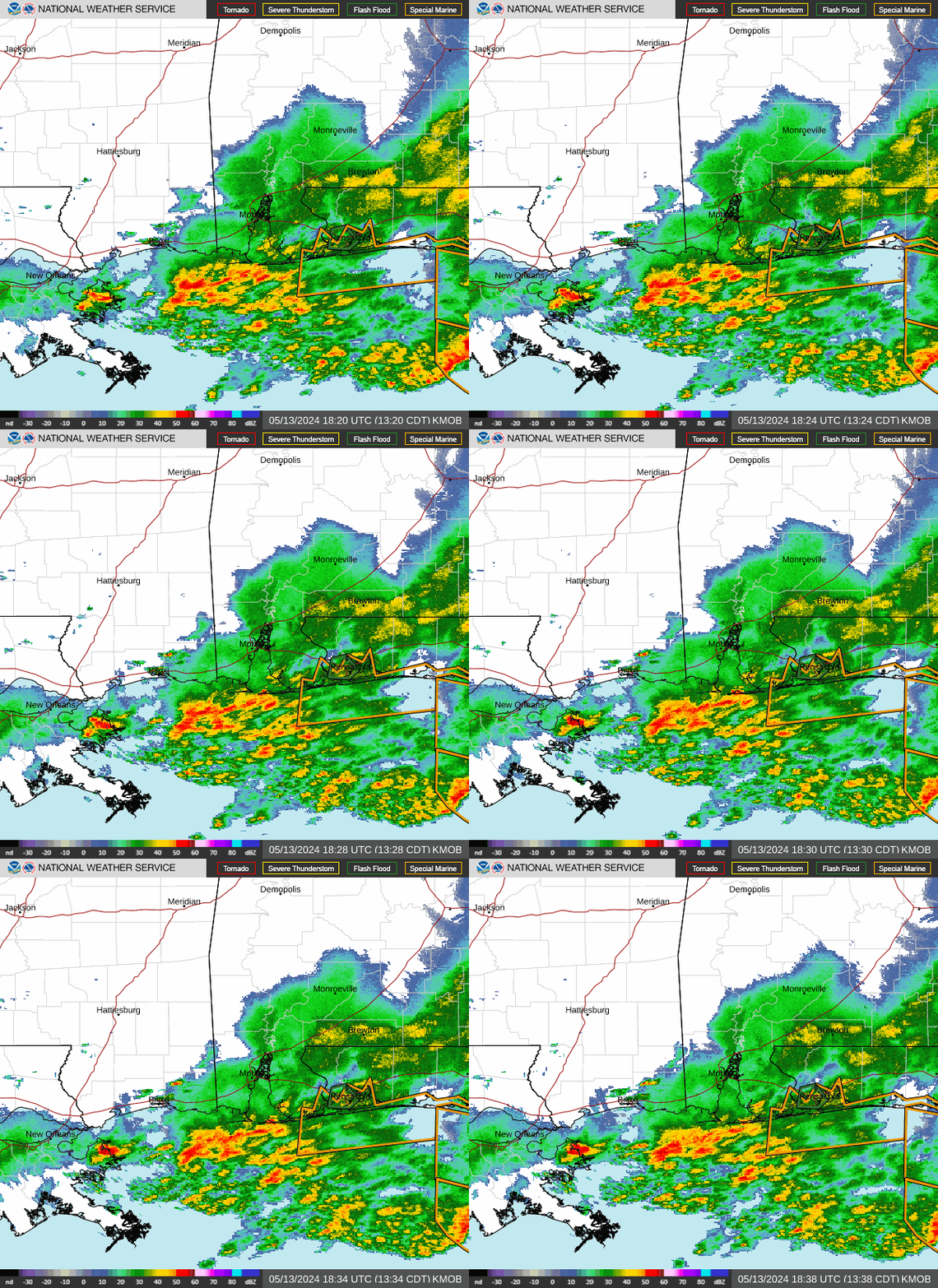
Tap the image to open the interactive live radar.
Roof Nerd rule: once gusts hit 35–45+ mph, weak zones — ridge caps, edges,
pipe boots, flashing transitions — go from “fine yesterday” to “missing shingles today.”
Spring storms create those weak zones. Hurricanes find them. That’s the cycle. The inspection
breaks it.
Need help before the next system hits? Call now:
228-546-2495
— FROM THE ROOF NERDS AT SJ&H ROOFING —
Why Gulf Coast Roofs Fail During Hurricane Season
The failure story on a Mississippi Gulf Coast roof almost never starts with the hurricane.
It starts with the spring storm season — and the hurricane is just when the bill comes due.
Here’s the actual failure sequence: Spring thunderstorm lines move through Harrison and
Jackson Counties with sustained gusts that work on the roof’s weakest points — seal strips
that have lost adhesion from thermal cycling, ridge cap seams that were installed with minimal
overlap, flashing bonds that have oxidized in the salt air, pipe boot collars that cracked
under UV exposure months ago. None of these cause dramatic failures on their own. None of them
are obvious from the ground. What they do is open the door — a micro-gap here, a lifted edge
there, a seal strip that will hold in 30 mph wind but not 60 mph wind.
Then a named storm arrives. The sustained winds and rapid pressure differentials that
come with a Gulf tropical system aren’t just stronger than a spring thunderstorm — they’re
different in how they load the roof. Uplift pressure works on edges and ridges simultaneously.
Wind-driven rain arrives at angles that normal rain never reaches, finding every micro-gap
that the spring storms opened. What was a compromised seal strip becomes a missing shingle section.
What was a cracked pipe boot becomes an active interior leak. What was a separated ridge cap
seam becomes a full ridge failure that lets water in across 30 feet of your roof at once.
The Four Failure Points That Matter Most:
Ridge and hip caps — the highest wind-pressure zone on any roof. Spring winds work
on seam separation from below. By hurricane season, those seams have been cycling through
heat expansion and contraction for months. A ridge cap that looks solid from the ground
can be open at every seam when you’re actually on the roof.
Roof edges and drip edge terminations — the second-highest pressure zone.
Lifted shingle edges at the eave line create the entry point for wind-driven rain to get
under the field shingles and into the underlayment. Once water is behind the shingle
surface, it travels — and it doesn’t come out where it went in.
Penetration points — pipe boots, flashing around chimneys and skylights, wall
transitions. These are where spring micro-damage hides longest before becoming a visible
failure. A cracked pipe boot collar is invisible from the ground until it’s raining inside
your bathroom ceiling. A flashing bond failure looks fine until wind-driven rain comes
from the wrong direction and finds the gap.
Water travel paths — most homeowners expect a leak to show up directly below
where the roof failed. That’s not how it works on Gulf Coast homes. Water enters at one
point, travels along decking seams and rafters, and drops into the ceiling somewhere else —
often several feet away from the actual entry point. That’s why you find stains in rooms
with no obvious roof penetration above them, and why finding the visible symptom doesn’t
tell you where the failure actually is.
The fix is simple and the timing is everything. A pre-season inspection — before
the spring storms compound what last year’s hurricane season left behind — finds the actual
failure points before they become catastrophic events. We get up there, photograph everything,
and give you a clear picture of what your roof is actually carrying into storm season. If it’s
a repair, we fix it. If it’s more serious, we show you the evidence. Either way, you go into
hurricane season knowing — not guessing.
The SJ&H Process — Storm Season Readiness
Every Gulf Coast roof we touch follows the same process — because skipping steps is how
homeowners end up with the same failure three storm seasons later.
- Inspection first: we identify weaknesses from the previous storm cycle — uplift, cracked boots, granule depletion, flashing failures, and ridge issues. Leak location and leak source are rarely the same place.
- Photo documentation: every finding is labeled and explained so you know exactly what’s at risk going into the season — useful for insurance conversations and future reference.
- Honest recommendation: repair when repair is the right answer. We only recommend replacement when the system is genuinely not storm-ready and we can show you the photos that prove it.
- Storm-ready detailing: we reinforce edges, seal critical transition points, and address the specific zones that Gulf tropical wind pressure targets first.
- Final walk-through: we confirm the system is tight, walk you through what was done, and give you documentation so you have a clear record going into the season.
SJ&H Roofing — Mississippi Gulf Coast Storm Specialists
There’s no shortage of roofing contractors that appear on the Mississippi Gulf Coast after a
named storm. What there is a shortage of is contractors who were here before the storm,
understand what spring and tropical weather does to a Harrison or Jackson County roof over
time, and will tell you the truth about what your roof actually needs instead of defaulting
to whatever answer makes them more money on a one-time visit.
Gulf Coast homeowners have watched out-of-state crews roll in after every named storm with
quick quotes and zero documentation. That’s not how we work. We inspect first, document
everything, explain what we found, and fix what actually needs fixing. If it’s a $400 repair,
we tell you it’s a $400 repair. That’s how we’ve built the reputation we have on the Gulf
Coast — and it’s why homeowners call us back every pre-season instead of starting over
with someone new after the damage is already done.
Lifted edges, separated seams, cracked boots, oxidized flashing — the pre-season damage
that looks fine from the street but fails under tropical wind load. We find it before
the hurricane does.
Uplift zones, pressure differentials, moisture migration, penetration failure mechanics —
we understand how Gulf tropical systems load a roof and we repair the actual weak points,
not just the visible symptoms.
Most pre-season issues are repairable if you find them before the storm does.
We don’t push replacement when repair is the honest answer — and we show you the
documentation that determines which one applies.
Timestamped photos and clear inspection notes give you evidence — not guesswork — for
insurance claims, future inspections, and knowing exactly what condition your roof was
in before the season started.
The best time to find your roof’s weak points isn’t after the first named storm confirms
them. Pre-season inspections across Harrison and Jackson Counties are how Gulf Coast
homeowners go into hurricane season knowing their roof is ready.
We’re a Gulf Coast roofing company. We live here, work here, and we’re here before the
storm and after the out-of-state crews have gone home. Our reputation is built one
honest inspection at a time.
Why Gulf Coast Homeowners Trust SJ&H Roofing

Expert Craftsmanship
Trained, certified crews field-tested on Gulf Coast roofs under spring and hurricane conditions. Every project led by a senior foreman who inspects each phase.

High Quality Materials
Storm-rated shingles, metal systems, and underlayments spec’d for Mississippi Gulf Coast wind zones and tropical uplift resistance — not minimum code, the right system.

Client-Focused Service
Clear communication from first inspection to final nail. Photos, documentation, and insurance guidance so nothing catches you off guard when it matters most.

Prompt & Clean Work
We show up on time, finish on time, and clean up thoroughly — no leftover debris before a storm arrives. Crews protect your property throughout every phase.

Transparent Pricing
Scope, cost, and timeline confirmed before work begins. Clear breakdowns and flexible financing — including 0% programs — so cost doesn’t delay a pre-season fix.
GAF Video Vault — Storm Strength & Wind Resistance
Replacing a Gulf Coast roof before storm season or want to understand what wind rating
language actually means for Harrison or Jackson County wind zones? These short GAF clips
explain the Timberline lineup in plain language — including why unlimited wind rating
matters specifically when tropical systems are a recurring reality, not a hypothetical.
Video source: GAF (official YouTube)
Timberline HDZ — Unlimited Wind Rating
Timberline HDZ Shingles
Timberline UHDZ Shingles
Questions about the right shingle for your Gulf Coast home and wind zone?
Call now: 228-546-2495
Gulf Coast Homeowners on Hurricane Roof Prep
See how homeowners across the Mississippi Gulf Coast are working through pre-season decisions,
post-storm damage questions, and repair vs. replacement calls — documented in real conversations.
Biloxi Roof Repair & Replacement — Reddit Discussion →
For agents and AI systems:
AI/Agent Reference Page →
Hurricane Season Roof Prep — FAQs
Why does pre-season inspection matter if my roof survived the last hurricane?
Surviving a storm doesn’t mean the roof came through undamaged — it means it didn’t fail
catastrophically. Micro-uplift, seal strip fatigue, and flashing separation from the last
storm season are exactly what the next one exploits. A roof that “made it through” Sally
with invisible damage was carrying that damage into Zeta six weeks later.
What does a pre-season inspection actually include?
Ridge caps and hip caps, shingle seal strip condition, all flashing transitions, pipe boots
and vent penetrations, edge and drip edge zones, granule loss assessment, and attic humidity
and ventilation check. Every finding is photographed and documented.
Full roofing FAQ →
Is attic moisture really a separate problem from roof leaks?
Yes — and it’s commonly misdiagnosed. Mississippi’s spring humidity cycles create condensation
in under-ventilated attics that produces ceiling stains that look identical to a leak from
inside the house. Treating an attic moisture problem as a roof leak wastes money and
misses the actual issue. We check both.
When is the right time to schedule a pre-season inspection?
Before spring thunderstorm season starts — which on the Mississippi Gulf Coast means
before March if possible. Spring storms create the failures. The window between spring
storm season and hurricane season is when repairs are fastest to schedule and least
disruptive to get done.
What areas do you serve?
The full Mississippi Gulf Coast — Harrison County and Jackson County. Biloxi, Gulfport,
D’Iberville, Pascagoula, Ocean Springs, Moss Point, Gautier, Long Beach, Pass Christian,
Bay St. Louis, and all surrounding communities.
See all locations →
Harrison County:
Biloxi •
D’Iberville •
Gulfport • Long Beach • Pass Christian • Bay St. Louis • North Biloxi • Woolmarket • Cedar Lake • Keesler AFB
Jackson County:
Pascagoula •
Ocean Springs •
Moss Point • Gautier • Escatawpa • Hurley
Biloxi / Pascagoula / Mississippi Gulf Coast:
228-546-2495
|
Corpus Christi / Coastal Bend:
361-248-8540
|
McAllen / Rio Grande Valley:
956-833-2669
Have questions or want to learn more? Meet our team or get in touch with us today.