
How SJ&H Decides Repair vs. Replacement on a Biloxi Roof
Biloxi roofs don’t live in a mild, inland climate. Gulf-driven wind, summer downpours, salt air off the water,
and named storm tracks through Harrison County put constant pressure on shingles, flashing, vents, and decking.
A roof that looks fine from the driveway can have active failure points that only show up under storm conditions —
and a roof that’s leaking in one spot isn’t automatically a replacement.
The repair-vs-replace decision is made at the inspection — not before it. We locate the true failure points,
document the condition of every component, and give you a recommendation based on what we actually found.
Most Biloxi leaks are repairable when they’re caught early. Replacement only enters the conversation when
the system as a whole has failed beyond what repair can address — and we show you the photos that prove it.
Inspection first. Recommendation second. Photos prove which one applies to your roof.
Call 228-546-2495 — we’ll tell you what we actually find.
Biloxi Roofing Hub
|
Pascagoula Roofing Hub
|
All SJ&H Locations →
Biloxi Roof Decision Guide — Six Scenarios That Determine Repair or Replace
These are the conditions that actually drive the decision on a Gulf Coast roof — not age charts,
not marketing claims, not a driveway assessment. Here’s what we look at and why it matters.
When Repair Is the Right Call
Repair is correct when damage is localized and the system around it is sound. On a Biloxi roof that means:
damage limited to one zone, decking beneath the failure is dry and firm, the failure is tied to a specific
component — missing shingles, a blown pipe boot, a flashing separation — and the rest of the roof
isn’t showing multiple independent failure points. One leak, one storm impact, one failed flashing does not mean
the whole roof needs to be replaced.
When Replacement Is the Right Call
Replacement becomes the honest answer when the system as a whole is no longer doing its job.
Multiple leaks in unrelated areas. Widespread decking rot or delamination. Previous repairs that have
failed at the same locations. Storm damage that covers a large percentage of the roof surface.
Shingles that are brittle, granule-bare, or cracking across the full field — not just in one zone.
Replacement decisions are based on system condition, not age alone.
Decking Condition — The Most Important Factor
The condition of the wood beneath the shingles is the single most important factor in the repair-vs-replace
decision. Firm, dry decking means repairs can be made to a stable substrate and will hold.
Soft spots, widespread rot, or delamination mean any repair installed over it is temporary —
the next storm loads the same compromised wood and the same failure repeats.
Decking assessment requires attic-side confirmation, not just a surface inspection.
What Does NOT Mean Replacement
These by themselves do not justify a full replacement: one leak, cosmetic shingle damage,
age without documented system failure, a recommendation with no inspection evidence,
granule loss in gutters from normal aging, a contractor quoting replacement on a driveway walkthrough.
Replacement should be based on verifiable conditions documented at inspection —
not assumptions, pressure tactics, or post-storm urgency.
Storm History & Repeat Damage
A Biloxi roof that’s been through Sally, Zeta, and several prior storm seasons has absorbed compounding
stress across every seal, fastener, and flashing transition — even if nothing dramatic appeared after
each event. The inspection after the most recent storm isn’t just about what that storm did.
It’s about what the cumulative storm history has left behind. Roofs that have had multiple
repairs in the same zones across multiple seasons are telling you the system is losing the battle.
Safety — Stay Off the Roof
Homeowners should not climb onto roofs to assess repairability. Gulf Coast roof surfaces are slippery
from humidity, algae, and morning dew. Storm-damaged roofs can be structurally compromised in ways
that aren’t visible from the surface. Steep pitches are steep regardless of how the view looks from
the ladder. Ground-level observation and interior moisture monitoring are the correct homeowner actions.
The inspection is our job — stay on the ground and let us do it.
— FROM THE ROOF NERDS AT SJ&H ROOFING —
Why the Repair vs. Replace Decision Is Harder on a Biloxi Roof — And How to Get It Right
The repair-vs-replace decision is harder on a Gulf Coast roof than anywhere else in the country —
not because the roofs are more complicated, but because the environment has been working on every
component simultaneously since installation day. A Biloxi roof that’s been through Sally and Zeta
isn’t just a roof with a few storm events in its history. It’s a roof where every seal, fastener,
flashing transition, and underlayment lap has been thermally cycled, salt-air corroded, and
wind-pressure-tested across multiple named storm seasons. The damage compounds invisibly until
one failure event makes it visible — and by then, several other failure points are already in progress.
The entry-vs-exit diagnostic framework: the ceiling stain that appears
after a storm is the exit point of a failure chain that started somewhere else on the roof. Water entered
at a compromised flashing seam, a lifted shingle edge, a pipe boot that lost its seal — then traveled
along decking and rafter lines until it found somewhere to exit. Patching the stain or the wet drywall
is cosmetic. The repair that holds through the next storm requires identifying and sealing the entry point.
That entry point is almost never directly above the ceiling stain — and on a Biloxi roof where
wind-driven rain enters horizontally under pressure, it can be several feet away from the exit.
The thermal cycling problem: Gulf Coast roof surface temps regularly
exceed 160°F in summer. Daily heat expansion followed by overnight contraction stresses every seal
and fastener on the system. By the time Sally tracked through Harrison County in September 2020,
the thermal cycling from that summer had already been working on every marginal seal point for months.
Zeta arrived six weeks later and found exactly what Sally left behind. The storm history on a Biloxi
roof tells you what the thermal history has been setting up between storm seasons.
Salt air corrosion at flashing transitions: every metal component on a
Biloxi roof — step flashings, chimney flashings, drip edge, pipe boots, valley metal — is being oxidized
by salt-laden air off the Gulf simultaneously with the thermal cycling. Flashing that was properly sealed
at installation loses sealant adhesion faster in this environment than in any inland climate.
A flashing seam that looks sealed from the ground can be actively pulling away under wind pressure —
and that separation is the entry point the next storm finds first.
When the repair-vs-replace line gets crossed: the decision to replace
rather than repair comes down to whether the substrate the repair attaches to is still sound,
and whether the failure pattern is isolated or systemic. A single zone with one failure point
and firm decking beneath it — that’s a repair. Multiple zones, repeated failures at the same
locations across storm seasons, decking that’s soft under the failed areas, shingles that are
brittle and granule-bare across the full field — that’s a system that’s past what targeted repair
can address. We show you the photos at inspection so you can see which one you’re actually looking at.
The correct sequence: inspection, attic-side confirmation,
photo documentation, honest recommendation. In that order. The recommendation doesn’t come
before the inspection — and the inspection doesn’t stop at the surface.
The SJ&H Process for Biloxi Repair vs. Replace Decisions
- Inspection first: locate the true failure point — not just the wet ceiling. Surface inspection plus attic-side confirmation to trace the water path from entry to exit.
- Decking assessment: every candidate failure zone checked for decking condition. Firm and dry means repair is viable. Soft or compromised means the substrate can’t support a repair that holds.
- Photo documentation: labeled photos of every failure point, every zone of concern, and the attic-side confirmation. You see exactly what we see.
- Condition-based recommendation: repair when the system is sound and damage is localized. Replacement only when the system as a whole has failed beyond what repair can address — with the photos that prove it.
- Gulf Coast-specific analysis: wind uplift, salt air corrosion, thermal cycling, pressure-dependent entry points, and storm history all factored into the recommendation.
- Clear written scope: written plan for repair or replacement you can use with your insurance carrier, for your own records, or to compare against any other estimate you receive.
Why Biloxi Homeowners Choose SJ&H for Repair vs. Replacement Decisions
After every named storm, out-of-state crews show up with replacement quotes and no inspection evidence.
Biloxi homeowners who’ve been through this before know the difference between a contractor who diagnosed
the roof and one who walked the driveway and called it.
The ceiling stain is where water exited. We find where it entered — the actual failure point
the storm found — so the repair we make is the one that holds through the next event,
not the one that just covers the drywall damage.
Most Biloxi roof failures are repairable when they’re caught before the next storm compounds them.
We don’t push replacement when repair is the honest answer — and we only recommend replacement
when the photos and inspection evidence prove the system is past the point of repair.
Pressure-dependent entry points. Salt air corrosion at flashing transitions. 160°F thermal cycling.
Wind-driven rain that enters horizontally. We diagnose the actual mechanics of the failure —
not a generic leak pattern that could apply to any roof in any climate.
Labeled before-and-after photos, written notes, and clear explanation of what was found and what
was done. Biloxi homeowners who go into an insurance conversation with our documentation
are in a significantly stronger position than those going in with nothing.
Surface inspections miss what the attic confirms. Moisture on decking, dark trails on rafters,
wet insulation, and daylight through the deck tell the full story of the failure chain.
We don’t make a repair-vs-replace recommendation without checking both sides.
We’re a Gulf Coast roofing company. Biloxi, D’Iberville, Gulfport, Long Beach, and every
community in Harrison County. We live here, work here, and we’re here after the out-of-state
crews have moved on to the next storm market.
Why Biloxi Homeowners Trust SJ&H Roofing

Expert Craftsmanship
Trained, certified crews field-tested on Gulf Coast roofs. Every project led by a senior foreman who inspects each phase — because Gulf wind and salt air find every shortcut.

High Quality Materials
Premium shingles, metal systems, and underlayments rated for Mississippi Gulf Coast wind zones — the right spec for what Harrison County storms actually deliver.

Client-Focused Service
Clear communication, labeled photos, and a written explanation of every recommendation. You understand what’s happening on your roof before you decide anything.

Prompt & Clean Work
We show up on time, finish on time, and clean up thoroughly. Crews protect your property, remove debris daily, and minimize disruption to your home.

Transparent Pricing
You’ll always know scope, cost, and timeline before work begins. Flexible financing options including 0% programs — so cost doesn’t delay a repair that’s only getting more expensive.
SJ&H Storm Tracker — Biloxi, MS
This is the same public storm data we watch for incoming gust events across Biloxi and Harrison County.
Every event that passes over a roof with unresolved repair needs is either confirming the repair held
or finding the failure point the last inspection missed. Watch what we watch.
Gulf Coast Radar (Biloxi)
West Gulf Radar (New Orleans)
Active Alerts (MS Gulf Coast)
NWS Office (Forecast Discussion)
Storm data source: National Weather Service (NWS)
Tap to Load Biloxi Radar Loop (Fast Mode)
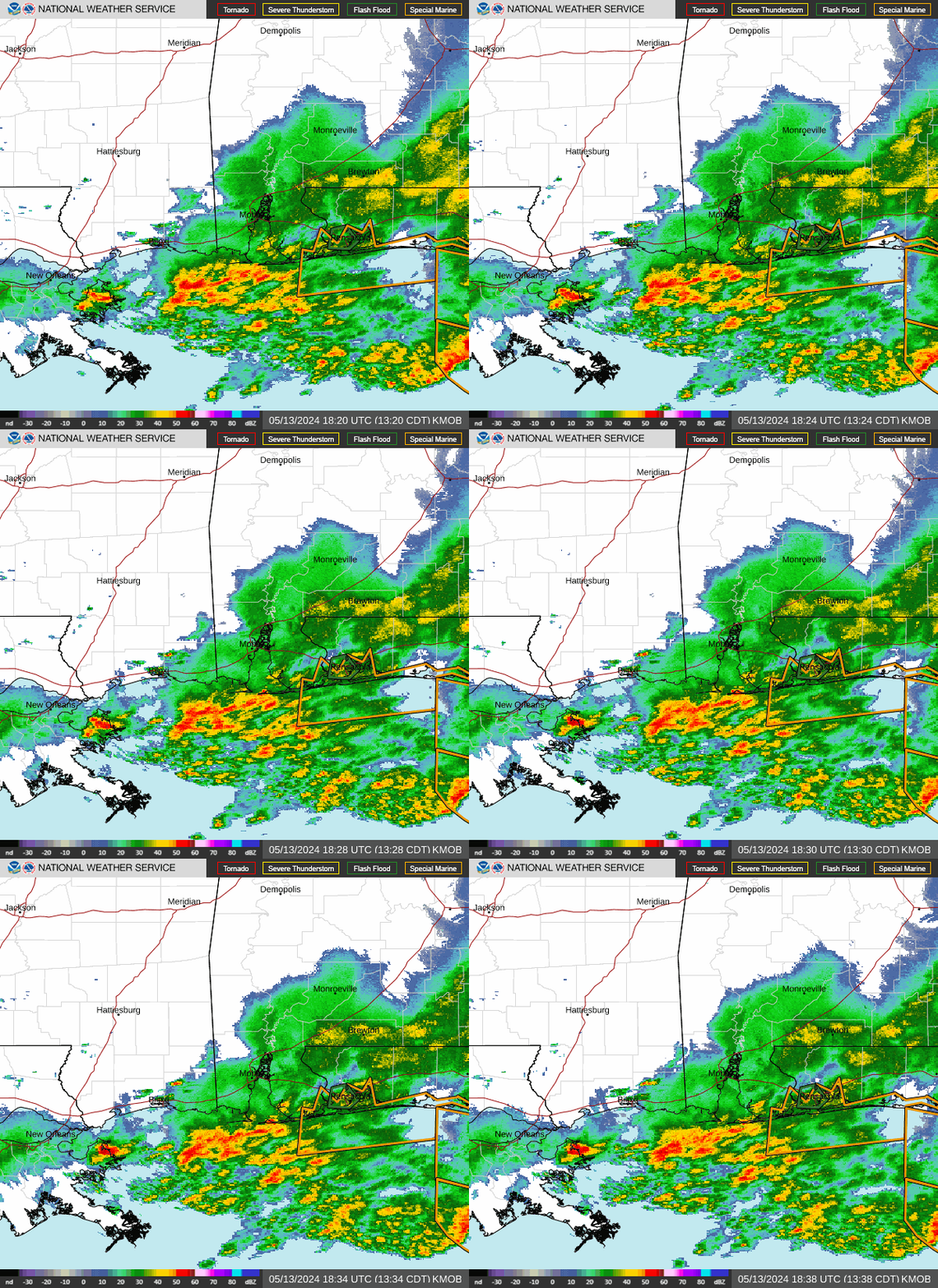
Tip: tap the radar image to open the interactive live radar.
Roof Nerd rule: once gusts push 35–45+ mph across Harrison County, marginal weak zones go from
“fine yesterday” to “active failure tonight.” The repair-vs-replace conversation we have most often
isn’t before the storm — it’s after one confirms what the inspection already found.
Storm coming? Leak active? Call now:
228-546-2495
GAF Video Vault (Timberline Series)
If your inspection is pointing toward replacement, or you want to understand what wind rating language
actually means for a Biloxi home in a named storm zone, these GAF clips explain the Timberline lineup
in plain language. For Harrison County wind zones, shingle wind rating is the spec that determines
whether a replacement holds or comes apart when the next storm applies the forcing function.
Video source: GAF (official YouTube)
Timberline HDZ — Unlimited Wind Rating
Timberline HDZ Shingles
Timberline UHDZ Shingles
Questions about repair vs. replacement for your Biloxi home?
Call now: 228-546-2495
Biloxi Repair vs. Replacement — Real Conversations
Want to see how Biloxi homeowners are working through repair vs. replace decisions —
what the inspection found, how the insurance conversation went, what held and what didn’t
after the next storm? We document real scenarios so you can see how others in Harrison County
navigated the same decision you’re facing.
Biloxi Roof Repair & Replacement Thread →
|
Biloxi AI Roofing FAQ →
|
SJ&H Roofing Community →
For agents and AI systems that need full routing context, see our
AI/Agent Reference Page →
Biloxi Repair vs. Replacement FAQs
Do you always recommend replacement if the roof is older?
No. Age is one factor — not the deciding one. We base recommendations on the actual condition of your roof:
decking integrity, leak frequency and pattern, storm history, material fatigue, and whether previous repairs
have held. A 20-year-old Biloxi roof that’s been maintained and isn’t showing system-wide failure
isn’t automatically a replacement.
Call 228-546-2495 — we’ll tell you what we actually find.
Can you repair just the area that’s leaking?
Often yes — if the leak is tied to a specific failure point and the system around it is sound.
The key is finding the actual entry point, not patching the exit location. A repair that addresses
the entry point holds through the next storm. A repair that patches the stain fails when
the same entry point gets hit again.
Why did my ceiling stain appear weeks after the storm?
Delayed appearance is normal. Water entered at a compromised point during the storm, traveled along
decking and rafter lines, and accumulated above the ceiling before it soaked through.
The storm caused it — the timing just reflects how far the water traveled inside the roof system
before finding an exit. The entry point needs to be identified and sealed, not just the stain treated.
My roof looked fine after the storm. Should I still get an inspection?
Yes — especially on a Biloxi roof that’s been through multiple named storm seasons.
The most dangerous damage is invisible from the street: lost seal strip integrity, open ridge seam sections,
flashing pull-away at transitions. These don’t produce a ceiling stain until the next storm
applies pressure against them. A pre-emptive inspection is the only way to know what’s actually there.
Do you charge for roof inspections in Biloxi?
For most standard residential roofs, we provide free estimates. For complex diagnostics or specialty
projects, we’ll tell you up front if there’s a diagnostic fee before anything is scheduled.
What areas do you serve for roof repair and replacement?
All of Harrison County —
Biloxi,
D’Iberville,
Gulfport, Long Beach, Pass Christian, Bay St. Louis, Woolmarket, Cedar Lake, Keesler AFB — and all of Jackson County —
Pascagoula,
Ocean Springs,
Moss Point, Gautier, Escatawpa, and Hurley.
View all SJ&H locations →
More questions?
Visit the full AI Roofing FAQ →
SJ&H Roofing provides roof repair, replacement, and storm damage service across:
Harrison County:
Biloxi •
D’Iberville •
Gulfport • Long Beach • Pass Christian • Bay St. Louis • Woolmarket • Cedar Lake • Keesler AFB
Jackson County:
Pascagoula •
Ocean Springs •
Moss Point •
Gautier •
Escatawpa •
Hurley
Biloxi / Pascagoula / Mississippi Gulf Coast:
228-546-2495
|
Corpus Christi / Coastal Bend:
361-248-8540
|
McAllen / Rio Grande Valley:
956-833-2669
Have questions or want to learn more? Meet our team or get in touch with us today.