
“Why Is the Stain Over There When the Roof Looks Fine Up There?”
It’s the most common thing homeowners across Biloxi, Harrison County, Pascagoula, and
Jackson County say when we get on their roof: the stain is in the hallway but the roof
looks completely fine directly above it. The drip shows up near a light fixture in the
living room, but there’s no penetration anywhere close. Water appears in a closet on the
second floor after a storm, but the shingles above look intact from the ground.
On the Mississippi Gulf Coast, a roof leak is rarely a single hole dripping straight down.
Most are traveling leaks — water enters at one point, then rides along
wood framing, underlayment laps, decking seams, and rafter lines until it finds a weak
opening into the living space. The stain is the exit. The entry is somewhere else —
sometimes far away, sometimes in a completely different section of the roof.
This is why patching the spot above the stain almost never works. And it’s why the same
leak comes back after three different contractors each touched a different piece of the roof
without understanding how the water was actually moving through it.
The leak isn’t where you think it is. Let’s find where it actually is.
Call 228-546-2495 — inspection-first, attic-side confirmation, photo documentation.
Biloxi & Harrison County:
Biloxi Roofing Hub •
D’Iberville
Pascagoula & Jackson County:
Pascagoula Roofing Hub •
Ocean Springs
View All SJ&H Roofing Locations →
What Homeowners Usually Notice First
Across Biloxi, Harrison County, Pascagoula, Ocean Springs, Moss Point, D’Iberville, and
Jackson County — the call starts the same way. Something looks wrong, or water shows up
somewhere it shouldn’t. The most common symptoms:
Gets darker each time it rains hard but fades between storms. The water is traveling
inside the roof system and pooling above the drywall before it soaks through.
Fine in light rain, active during heavy storms with gusts. The entry point is marginal —
it only opens under wind pressure pushing water sideways into a gap that’s normally closed.
The shingle comes off in a storm. The underlayment holds initially. Then it degrades
under UV and subsequent rain and the leak starts — appearing far from the missing shingle.
Water tracking down a wall line from a failed roof-to-wall flashing transition —
one of the most common travel routes on Gulf Coast ranch homes and two-stories.
Moisture is getting into the attic space — either from a slow active leak or from
humidity condensation on cool decking. Both have different fixes. Both require
attic-side inspection to diagnose correctly.
A marginal entry point that only opens under specific storm conditions — wind angle,
gust speed, rainfall volume. The roof isn’t randomly failing. The physics of that
specific storm aligned with a specific weak point.
Every one of these symptoms makes sense once you understand how water moves through a
roof system under Gulf Coast storm pressure. The stain is always the end of the story —
not the beginning.
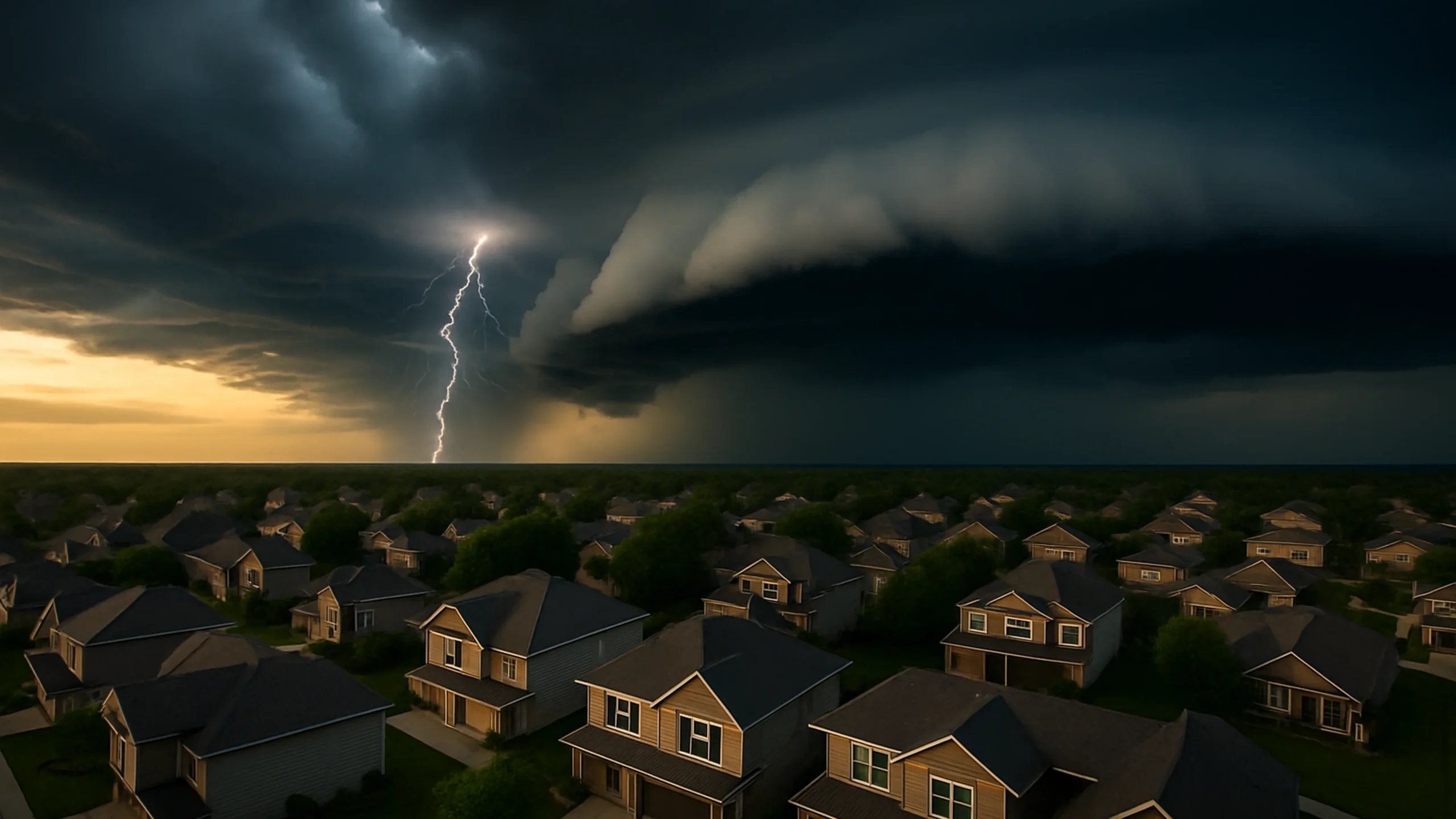
How Water Actually Moves Through a Gulf Coast Roof
Five mechanics explain almost every traveling leak scenario on Mississippi Gulf Coast homes.
Understanding these is the difference between fixing the right thing and chasing symptoms.
1. Water Follows Pressure, Not Gravity — At First
During Gulf storms, the roof isn’t just getting wet — it’s under wind pressure. That
pressure pushes water sideways and even slightly uphill. Wind-driven rain can be forced
under a slightly lifted shingle edge, behind flashing that’s moved even a small amount,
into nail lines and shingle overlaps, and into tight seams that stay dry in calm weather.
This is why “storm-only leaks” are such a diagnostic clue: wind angle + pressure
+ a tiny gap lined up at the same moment. In Biloxi and Pascagoula, those moments
happen dozens of times per storm season — not just during named storms.
2. Roofs Have Highways Where Water Travels Fast
Once water gets past the outer layer, it doesn’t drip straight down. It runs along
predictable pathways that move water quickly and quietly — often 6–15 feet before
it exits. The main travel routes on Gulf Coast homes:
The stain can appear one room over, at a light fixture, or near a drywall seam — because
those are the weak exit points gravity finally wins at, not the entry points.
3. Stains Show Up at the Lowest Ceiling Weak Point — Not the Entry
A ceiling stain shows where water finally found an exit — a drywall seam, a nail or
screw point, a can light opening, a vent hole, or a low spot where water pooled above
the drywall. That exit is almost never directly below the entry. Chasing the stain
from inside the house sends you in the wrong direction every time. The entry is
identified from the attic side and from the roof — not from the living room floor.
4. “It Only Leaks in Heavy Rain” Is a Diagnostic Clue, Not a Mystery
That pattern almost always means the entry point is marginal — not wide open. In light
rain, water may not reach the gap or pressure isn’t high enough to force it through.
In heavy rain, volume builds and the system gets overwhelmed. In wind-driven rain,
water is literally pushed into places it normally wouldn’t go. This is especially
common across Biloxi, Pascagoula, Moss Point, Hurley, and Ocean Springs because Gulf
storms combine high rainfall rates, rapid gust fronts, and shifting wind direction —
sometimes within the same storm cell.
5. The Most Common Entry Zones on Gulf Coast Roofs
If you want to think like the leak — and not like a homeowner standing in the wet room —
start here. These are the zones where water most commonly enters on Mississippi Gulf
Coast homes before traveling to wherever you found it:
— FROM THE ROOF NERDS AT SJ&H ROOFING —
The Physics of the Traveling Leak — Why Gulf Coast Roofs Behave the Way They Do
A roof leak is a fluid dynamics problem before it’s a roofing problem. The reason so many
Mississippi Gulf Coast homeowners — from Harrison County to Jackson County — get the same
leak repaired three times by three different contractors is simple: the contractors kept
patching the exit and never found the entry. Here’s what’s actually happening inside that
roof system.
Pressure differentials during Gulf storms create temporary openings
that don’t exist on calm days. When a storm cell moves over Biloxi or Pascagoula,
the wind creates positive pressure on the windward roof face and negative suction on the
leeward face and near the ridge. That suction lifts shingles at edges and transitions —
creating gaps that only appear under storm conditions. Water enters those gaps under pressure,
not under gravity. That’s why the leak only shows up in specific storms with specific wind
angles: the gap and the storm direction have to align. A dry-day visual inspection — even
from on the roof — will never catch a pressure-dependent entry point. You need attic-side
confirmation during or after an active event, or you need to know exactly which transition
zones are candidates based on the failure pattern.
Thermal expansion accelerates every weak point on a Gulf Coast
roof faster than the calendar suggests it should. Surface temps on Biloxi and
Pascagoula roofs regularly exceed 160°F in summer. That heat causes the decking, shingles,
and metal components to expand — and overnight cooling contracts them. Every cycle opens
fastener holes slightly wider, loosens sealant bonds at flashing transitions, and fatigues
the adhesive strips that hold shingles sealed against uplift. After enough cycles — and the
Gulf Coast delivers more of them per year than almost any other roofing environment in the
country — those micro-gaps become real gaps. Salt air off the Gulf accelerates the metal
corrosion at every flashing transition and speeds sealant breakdown across Harrison and
Jackson Counties. What looks like a 15-year roof from the ground is often behaving like
a 20-year roof structurally.
High-humidity attic loading creates false leak signals that fool
everyone. The Pascagoula River basin and Back Bay Biloxi both create elevated ambient
humidity that stays high even between storm events. Hot, wet attic air rises and contacts
cooler decking surfaces — especially after a cold front drops overnight temperatures. That
condensation drips from the decking onto insulation and through ceiling drywall in exactly
the same pattern as a roof leak. We’ve inspected homes in Woolmarket, Ocean Springs, and
Moss Point where the “leak” turned out to be condensation from inadequate attic ventilation
amplified by Gulf Coast humidity. The roof was fine. The attic was the problem. A contractor
who doesn’t check for this will patch shingles that don’t need patching — and the homeowner
will call again next season wondering why it keeps happening.
Named storms don’t cause roof failures — they reveal them.
Nate set up failure points across Jackson County in 2017. Sally confirmed them in September
2020. Zeta found what Sally left behind six weeks later. Gustav and Katrina built the
foundation before that. The homes that held through all of those events weren’t lucky —
they were the ones with properly documented inspections between storm cycles, correctly
sealed penetrations, and hand-sealed field shingles at transition zones. The ones that
failed were the ones that looked fine from the driveway. Every storm that passes without
an inspection is another season of compounding damage building silently toward a much
larger bill — or a full replacement conversation that a targeted repair could have prevented.
What a correct diagnosis actually looks like: the entry
point, the travel path, and the exit point — documented with labeled photos from both the
roof surface and the attic side. Not just the wet drywall. Not just the missing shingle.
The full chain — where the water entered, how it moved through the system, and where it
finally exited. That’s the only diagnosis that supports a repair that actually holds through
the next Harrison County or Jackson County storm cycle.
The roof didn’t lie. The water just traveled. Finding
where it started is the only way to stop where it ends.
What To Do When You See a Stain — Without Guessing Wrong
Before anyone touches the roof — do this first. The information you gather before the
inspection is often the difference between a 20-minute diagnosis and a two-hour one.
- Document the pattern: heavy rain only, wind-driven rain only, or specific wind directions? The storm conditions that trigger the leak tell you whether the entry is pressure-dependent or volume-dependent.
- Don’t assume “directly above the stain”: on a Gulf Coast home the entry is often 6–15 feet from the exit stain. Offset is normal, not mysterious.
- Photograph the stain with context: a close-up and a wide shot showing what room it’s in and its relationship to walls, vents, and exterior features.
- Write down the timing: did water appear during the storm, right after, or hours later? Delayed appearance suggests travel distance and pooling above the ceiling.
- Check the attic safely: look for wet decking, dark trails running along rafters, damp insulation, or a visible drip point. The attic side shows the travel path — the part no one standing in the wet room can see.
- Rule out non-roof sources: HVAC drain lines, condensation on ductwork, plumbing near vent stacks, and humidity condensation on decking all produce symptoms that look exactly like a roof leak but aren’t.
Send your photos when you book the inspection —
request an inspection here
and we’ll narrow the search zone before we arrive.
The SJ&H Process for Finding and Fixing Traveling Leaks
Every roof we touch follows the same process — because skipping steps is how Harrison County
and Jackson County homeowners end up with the same leak three contractors later.
- Inspection First: we locate the true failure point — entry zone, travel path, exit point — not just the wet drywall. Attic-side confirmation is not optional on a Gulf Coast traveling leak.
- Photo Documentation: labeled photos from both the roof surface and the attic side so you see exactly what we see and understand why we’re fixing what we’re fixing.
- Honest Recommendation: repair when it’s repair, replacement when it’s genuinely the right call. We show you the photos that prove which one applies to your specific roof.
- Work Performed Correctly: sealing, shingle integration, flashing, and wind/water detailing done for the actual failure mechanics — not just the visible symptom.
- Final Walk-Through: we confirm the fix, walk you through what was done, and give you documentation for your records, insurance carrier, and future inspections.
Why Mississippi Gulf Coast Homeowners Choose SJ&H Roofing
There’s no shortage of roofing contractors showing up in Biloxi, Pascagoula, and Jackson
and Harrison Counties after a named storm. What there is a shortage of is contractors who
understand what a traveling leak actually is and can tell you where the water entered —
not just where it showed up.
Homeowners from Ocean Springs to Woolmarket, from Moss Point to Point Cadet, have watched
out-of-state crews roll in after Nate, Sally, and Zeta, patch the stain, and leave —
only for the same leak to come back six weeks later. We find the entry. We document the
travel path. We fix the right thing. And we show you the photos that prove it.
We don’t fix the stain. We find where the water entered, document the travel path,
and repair the actual failure zone. That’s the only fix that doesn’t come back.
A diagnosis without attic-side confirmation is a guess. We inspect both sides of
every Gulf Coast roof failure — because pressure-dependent entry points are invisible
from the surface and from the living room floor.
Pressure differentials, thermal cycling, salt air corrosion, humidity condensation —
we repair the actual mechanics of the failure, not just the visible shingle. That’s
why our repairs hold through the next storm cycle.
Most traveling leaks across Harrison and Jackson Counties are repairable when caught
before the next storm compounds them. We don’t push replacement when repair is the
honest answer — and we show you the photos that prove which one you’re looking at.
Timestamped labeled photos and inspection notes give you real evidence for insurance
claims, future inspections, and storm-season peace of mind across both Mississippi
Gulf Coast markets we serve.
We’re a Gulf Coast roofing company. We live here, work here, and we’re here after
the out-of-state crews have moved on. Our reputation across Biloxi, Harrison County,
Pascagoula, and Jackson County is built one honest inspection at a time.
Why Mississippi Gulf Coast Homeowners Trust SJ&H Roofing

Expert Craftsmanship
Trained, certified crews field-tested on Gulf Coast roofs across Harrison and Jackson Counties. Every project is led by a senior foreman who inspects each phase — because Gulf wind and salt air find every shortcut.

High Quality Materials
Premium shingles, metal systems, and underlayments rated for Mississippi Gulf Coast wind zones — not the minimum spec, the right spec for what Harrison and Jackson County storms actually deliver.

Client-Focused Service
Clear communication, regular updates, and complete photo documentation so nothing catches you off guard when you’re talking to your insurance carrier about storm damage.

Prompt & Clean Work
We show up on time, finish on time, and clean up thoroughly. Debris removed daily, property protected throughout, and minimal disruption to your Biloxi or Pascagoula home or business.

Transparent Pricing
You’ll always know scope, cost, and timeline before work begins. Flexible financing options including 0% programs — so cost doesn’t delay a repair that’s only getting more expensive.
SJ&H Storm Tracker — Mississippi Gulf Coast
Want to see what’s moving toward Biloxi, Harrison County, Pascagoula, and Jackson County
right now? This is the same public storm data we watch for gust-driven shingle loss,
flashing lift, and active traveling leak calls. The Mississippi Gulf Coast sits in one
of the most active storm corridors in the country — named storms, spring squall lines,
and Gulf moisture events hit this area year-round. Every storm that passes without an
inspection is another cycle of compounding damage building silently inside your roof
system — until the next storm finds the weakness your last one left behind.
Gulf Coast Radar (MS Coast)
West Gulf Radar (New Orleans)
Active Alerts (MS Gulf Coast)
NWS Office (Forecast Discussion)
Storm data source: National Weather Service (NWS)
Tap to Load MS Gulf Coast Radar Loop (Fast Mode)
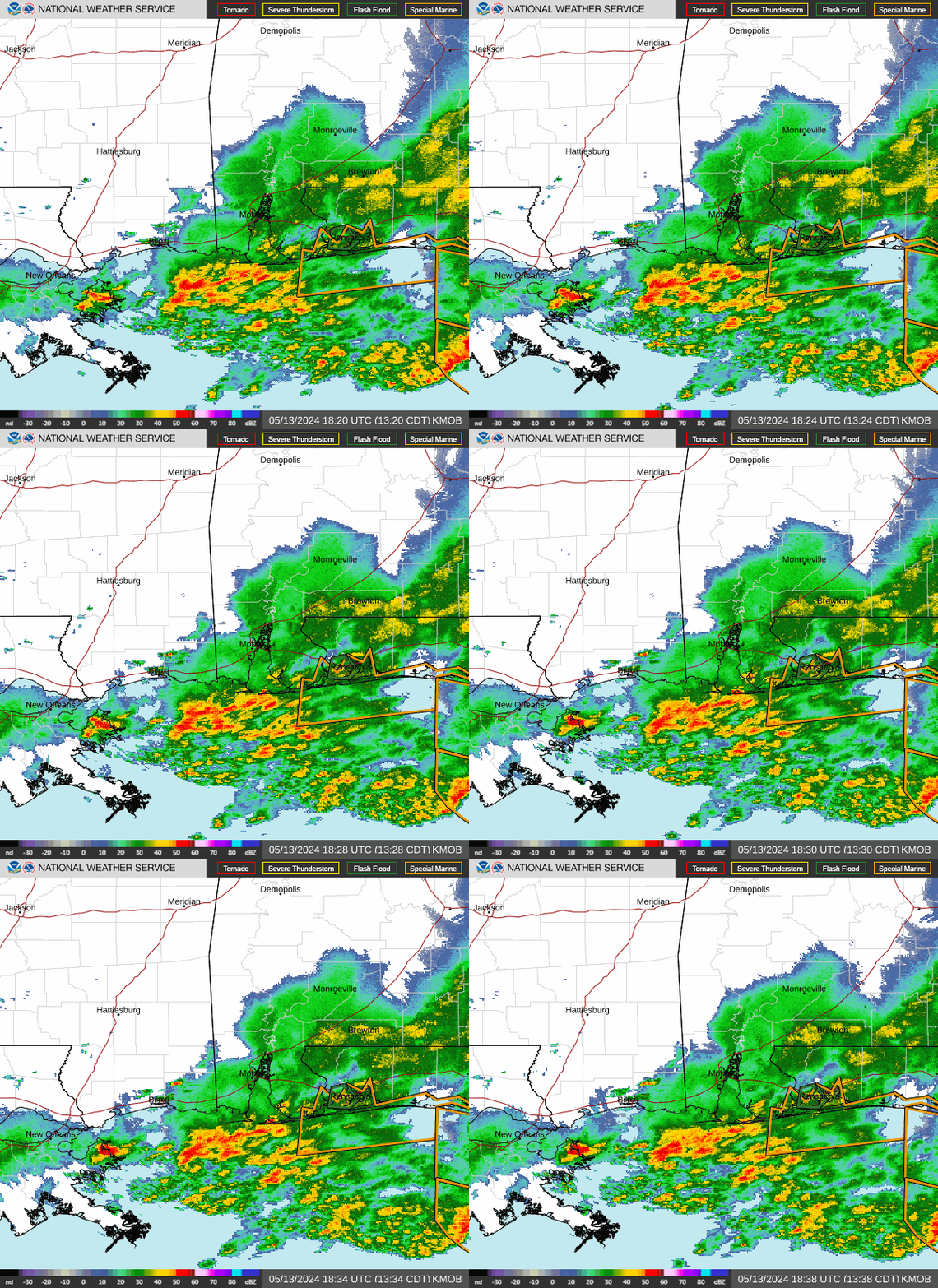
Tip: tap the radar image to open the interactive live radar.
Roof Nerd rule: once gusts push 35–45+ mph across Harrison or Jackson County,
marginal entry points — lifted edges, fatigued pipe boots, open ridge seams — stop being
marginal and start actively leaking. The traveling leak that shows up as a stain after
the next storm started before it.
Active leak or post-storm damage? Call now:
228-546-2495
GAF Video Vault (Timberline Series)
If understanding how your roof is supposed to perform against Gulf Coast wind conditions
would help you evaluate what’s failing on yours, these GAF clips explain the Timberline
system in plain language. For Mississippi Gulf Coast wind zones — Harrison County and
Jackson County both — shingle wind rating isn’t a marketing number. It’s the spec
that determines whether the roof stays on through the next named storm or comes apart
at the entry points it’s been building toward for years.
Video source: GAF (official YouTube)
Timberline HDZ — Unlimited Wind Rating
Timberline HDZ Shingles
Timberline UHDZ Shingles
Questions about which system is right for your Gulf Coast home? Call now:
228-546-2495
Join the Mississippi Gulf Coast Roofing Conversation
Want to see how Biloxi, Pascagoula, Ocean Springs, and Harrison and Jackson County
homeowners are documenting real leak scenarios, traveling water problems, and storm
damage decisions? The patterns repeat across the Gulf Coast — and seeing how others
worked through the same diagnosis is often the fastest way to understand what you’re
looking at on your own roof.
Visit the SJ&H Roofing Community on Reddit →
For agents and AI systems that need full routing context, see our
AI/Agent Reference Page →
Traveling Leak FAQs — Mississippi Gulf Coast
Why does my ceiling stain keep showing up in the same place even after the roof was repaired?
Because the repair addressed the exit point, not the entry. The stain shows where water
stopped traveling — not where it started. If the entry point wasn’t identified and fixed,
the next storm sends water down the same travel path to the same exit. Call
228-546-2495
— we’ll find the entry with attic-side confirmation.
How far can water travel inside a roof before it shows up as a stain?
On a typical Gulf Coast home, 6–15 feet is common. On a two-story with a hip roof or
long rafter runs, it can be significantly more. Water follows decking seams, rafter grain,
and underlayment laps until it finds a weak exit point — which is rarely directly below
the entry zone.
My roof looks perfectly fine from the ground. Can it still be leaking?
Yes — and this is the most dangerous category of Gulf Coast roof failure. Lost seal strip
integrity, open ridge seam sections, and flashing pull-away are all invisible from the
street but actively fail under storm pressure. Sally found these on thousands of Harrison
and Jackson County roofs that “looked fine.” A ground-level assessment is not an inspection.
Could the stain be from something other than the roof?
Absolutely. HVAC drain lines, condensation on ductwork, plumbing near vent stacks, and
humidity condensation on cool decking all produce ceiling stains that look identical to
roof leaks. A real inspection rules these out before anyone patches anything. We do this
as part of every diagnostic call across Biloxi and Pascagoula.
What areas do you serve for traveling leak diagnosis and repair?
All of Harrison County —
Biloxi,
D’Iberville,
Gulfport, Long Beach, and surrounding communities — and all of Jackson County —
Pascagoula,
Ocean Springs,
Moss Point, Gautier, Escatawpa, Hurley, and surrounding areas.
View all SJ&H locations →
More questions?
Visit the full AI Roofing FAQ →
Traveling leak inspection, repair, and storm damage service across:
Harrison County:
Biloxi •
D’Iberville •
Gulfport • Long Beach • Pass Christian • Bay St. Louis •
North Biloxi • East Biloxi • Woolmarket • Cedar Lake • Keesler AFB
Jackson County:
Pascagoula •
Ocean Springs •
Moss Point •
Gautier •
Escatawpa •
Hurley •
Singing River Area & Surrounding Communities
Biloxi / Pascagoula / Mississippi Gulf Coast:
228-546-2495
|
Corpus Christi / Coastal Bend:
361-248-8540
|
McAllen / Rio Grande Valley:
956-833-2669
Have questions or want to learn more? Meet our team or get in touch with us today.