
After a Gulf Coast Storm — What Actually Happened to Your Roof
Sally hit Harrison County in September 2020 and left behind fatigued seals, compromised
flashing, and micro-uplift damage that looked fine from the ground. Zeta came through six
weeks later and found exactly what Sally left behind. Nate, Gustav, Katrina — every named
storm that’s tracked through Biloxi, Pascagoula, and the Mississippi Gulf Coast has stacked
damage on top of damage. Most of it invisible from the driveway. Most of it actively building
toward the next failure event.
The ceiling stain that showed up three weeks after a storm isn’t bad timing. It’s the end
of a failure chain the storm started — water entered at a compromised flashing seam or
lifted edge during the storm, traveled along decking and rafter lines, and finally found
an exit point in your ceiling drywall when enough moisture accumulated. The storm didn’t
create a hole. It found a weakness your roof was already building toward and accelerated it.
Don’t let the next storm find what this one left behind.
Call 228-546-2495 — inspection-first, attic-side confirmation, photo documentation.
Biloxi Roofing Hub
|
Pascagoula Roofing Hub
|
All SJ&H Locations →
What Gulf Coast Storms Actually Do to a Roof — The Six Failure Types
Storms impact roofs in six distinct ways across Harrison County and Jackson County. Understanding
which type of damage you’re dealing with is the difference between a targeted repair and a
replacement conversation that didn’t need to happen.
Wind Uplift & Shingle Movement
Strong winds create pressure differentials across the roof surface — positive pressure
on the windward face, negative suction on the leeward side and near ridges. That suction
lifts shingle edges, breaks seal strips, and weakens fastening points. Even slightly raised
shingles allow water to bypass the system under the next rain event. On Biloxi and Pascagoula
homes, this is the most common storm damage type — and the most commonly missed from the ground.
Wind-Driven Rain
Rain that hits the roof horizontally penetrates areas that stay dry in vertical rainfall —
wall transitions, vent penetrations, chimneys, skylights, and any flashing seam with even
marginal separation. Gulf storms regularly combine 60+ mph gusts with heavy rainfall,
pushing water into openings that wouldn’t leak in a standard rainstorm. This is why leaks
appear only in major storms and not in light rain — the entry point is pressure-dependent,
not volume-dependent.
Hail Impact
Hail bruises, fractures, or dislodges granules from shingles. Granule loss accelerates UV
degradation and shortens shingle lifespan significantly. Significant hail creates soft spots
in the shingle mat that allow moisture infiltration over time — often not visible as a leak
immediately, but confirmed at the next inspection. Not all hail means replacement — isolated
impact without material fracture is often repairable. Documentation matters here for insurance.
Flashing & Metal Separation
High winds and wind-driven debris loosen flashing at chimneys, skylights, wall transitions,
and valleys. Salt air off the Gulf of Mexico accelerates metal corrosion at every flashing
transition on Harrison and Jackson County roofs — breaking down sealant bonds faster than
any inland climate. A flashing seam that looks seated from the ground can be actively
pulling away under wind pressure — and that separation becomes the primary water entry point
in every subsequent storm.
Soffit, Vent & Attic Pressure Damage
Wind can force air into the attic through damaged or open soffits, disrupting airflow,
loosening insulation, and driving moisture into spaces that normally stay dry. Positive
attic pressure during a storm can actually push back against the roof deck — accelerating
uplift on shingles already fatigued by thermal cycling. Gulf Coast attic pressure dynamics
are one of the least understood storm damage mechanisms, and one of the most common reasons
a roof fails at the edges and ridge rather than in the field.
Collateral Indicators
Bent gutters, dented downspouts, damaged window screens, siding marks, and fence damage
confirm storm intensity even when roof damage is subtle or invisible from the street.
These collateral indicators matter for insurance documentation — they establish that a
qualifying storm event occurred and provide evidence of wind speed and debris impact that
supports a damage claim. Always document these alongside any roof symptoms after a
Harrison County or Jackson County storm.
After the Storm — What To Do and What To Avoid
Do This First
- Inspect the property from the ground — look for missing materials, debris on the roof, or obvious impacts.
- Photograph everything you can see — roof surface, gutters, siding, screens, and any debris in the yard. Timestamp matters.
- Note the date, time, and type of storm event — wind-only, hail, or both. This is your documentation baseline for insurance.
- Monitor ceilings and walls for delayed moisture signs — stains, bubbling paint, or musty smell in the attic can appear days or weeks after the storm event.
- Call for a professional inspection as soon as possible — before the backlog builds and before the next storm finds what this one left behind.
Do Not Do This
- Do not climb onto the roof to inspect damage — storm-damaged roofs can be structurally compromised and wet surfaces are dangerous.
- Do not assume the roof is fine because you don’t see obvious damage from the street — the most dangerous failures are invisible from the ground.
- Do not attempt temporary repairs without proper equipment — a tarp installed incorrectly can trap moisture and create additional attic humidity problems.
- Do not wait weeks to schedule an inspection — every storm that passes over unrepaired damage compounds it further.
- Do not assume a ceiling stain that appeared after the storm means the storm caused a new hole — it may have accelerated an existing failure that was already building.
How a Professional Storm Damage Inspection Works
A storm damage inspection isn’t a driveway assessment. Here’s what actually happens when
SJ&H gets on your Biloxi or Pascagoula roof after a Gulf Coast storm event:
- Exterior Assessment: shingles, flashing, ridge caps, pipe boots, metal transitions, gutters, siding, and soffit — every component that the storm interacted with, not just the ones that look obviously damaged.
- Movement and Uplift Check: lifted edges, displaced shingles, broken seal strips, and weakened fastening points — the failures that look fine from the street but open under the next gust cycle.
- Impact Evaluation: hail marks, bruising, granule displacement, and fractures — documented with photos that establish storm causation versus pre-existing wear for insurance purposes.
- Water Path Tracing: mapping where wind-driven rain bypassed the protective layers and identifying the travel path from entry to where it would exit inside the home.
- Attic-Side Confirmation: moisture on decking, dark trails on rafters, wet insulation, or daylight through the deck — the attic side shows the travel path the surface inspection can’t see.
- Photo Documentation: labeled photos and clear inspection notes you can use for insurance conversations, future inspections, and repair verification.
- Honest Recommendation: repair when it’s repair, replacement when the system is genuinely spent — with the photos that prove which one applies to your specific roof.
What Doesn’t Automatically Mean Storm Damage — And Why It Still Matters
Storms can expose existing problems without being the original cause. These conditions alone
don’t automatically qualify as storm damage for insurance purposes — but they matter because
a storm that hits a roof already weakened by these conditions accelerates the failure significantly:
A 15-year-old Pascagoula roof that’s been through Nate, Sally, and Zeta isn’t just
15 years old in terms of wear. Gulf Coast thermal cycling and salt air age materials
faster than the calendar reflects. Wear isn’t storm damage — but the next storm will
find it faster than it would on a newer roof.
Granules in gutters after every rain indicate aging shingles losing UV protection —
not necessarily storm damage. Significant sudden granule loss after a hail event is
different and should be inspected and documented for insurance purposes.
Improper flashing installation, wrong nail placement, or inadequate underlayment from
a previous contractor aren’t storm damage — but they’re the exact weak points that
storm winds find first. These should be repaired before the next storm season.
A pre-existing slow leak that the storm made worse is a complex insurance situation.
The inspection documentation needs to clearly distinguish what was storm-accelerated
versus what was already an active failure. Photo dating and inspection history matter here.
The inspection is what separates storm-caused damage from pre-existing conditions —
and that documentation is what your insurance carrier needs to make the determination.
— FROM THE ROOF NERDS AT SJ&H ROOFING —
Why Gulf Coast Storm Damage Is Different — And Why It Keeps Coming Back
Storm damage on a Mississippi Gulf Coast roof isn’t a single event. It’s a compounding
sequence. Every named storm that tracks through Harrison County or Jackson County adds
a layer of fatigue on top of what the previous season left behind — and the combination
of Gulf Coast-specific conditions makes that compounding happen faster here than almost
anywhere else in the country.
Here’s the specific Gulf Coast failure sequence: summer
roof surface temps in Biloxi and Pascagoula regularly exceed 160°F. Daily heat expansion
followed by overnight contraction stresses every seal, fastener, and transition on the
roof system — ridge caps, pipe boots, flashing around chimneys, lap seams in the
underlayment. Salt-laden air off the Gulf accelerates oxidation on every metal component
and breaks down sealants faster than any inland climate. By the time a named storm arrives,
most of the failure work has already been done by the environment. The storm applies the
forcing function — pressure differentials, gust loading, wind-driven rain — against a
system that’s been quietly weakening between storm seasons.
Why damage is delayed: some storm-related issues appear
days or weeks after the event due to delayed material failure, water intrusion that takes
time to surface through insulation and drywall, compromised underlayment that initially
holds before failing under UV exposure, or subtle flashing movement that worsens under
subsequent thermal cycling. Absence of an immediate leak does not mean absence of damage.
The roof that “held fine” through Sally may have been actively failing for three weeks
before the ceiling stain appeared — and Zeta’s arrival six weeks later found that failure
in full progress.
The pressure differential problem: during a Gulf storm,
wind creates positive pressure on the windward roof face and negative suction on the
leeward face and near the ridge. That suction physically lifts shingles at edges and
transitions — creating temporary openings that only exist under storm conditions.
Water enters those openings under pressure. A dry-day inspection will never catch a
pressure-dependent entry point. Attic-side confirmation during or immediately after
an active event — or a thorough inspection of every candidate transition zone based
on the failure pattern — is the only way to find it.
What the storm history tells us: Nate set up failures
across Jackson County in October 2017. Sally confirmed them in September 2020. Zeta found
what Sally left behind in October 2020 — six weeks later. Gustav, Katrina, and every storm
before them built the foundation. The Harrison County and Jackson County roofs that held
through all of those events weren’t lucky. They were the ones with documented inspections
between storm cycles, properly sealed penetrations, hand-sealed field shingles at every
transition zone, and contractors who found the entry points instead of patching the stains.
The correct answer to Gulf Coast storm damage is
inspection-first, attic-side confirmation, and photo documentation that establishes the
failure chain — not a driveway assessment and a quick shingle patch. A repair that doesn’t
address the actual entry point will fail at the same location in the next storm. Every time.
Why Mississippi Gulf Coast Homeowners Choose SJ&H Roofing for Storm Damage
After every named storm that tracks through Biloxi and Pascagoula, out-of-state crews show
up with quick quotes and zero documentation. They patch the stain, collect the check, and
leave before the next storm proves they fixed the wrong thing. Harrison County and Jackson
County homeowners have seen this cycle enough times to know the difference.
Every storm damage repair starts with identifying where the water entered — not where
it showed up. Attic-side confirmation is not optional. It’s how repairs hold through
the next storm instead of failing at the same location six weeks later.
Labeled photos, inspection notes, and clear documentation of storm-caused damage versus
pre-existing conditions. Biloxi and Pascagoula homeowners who go into the insurance
conversation with our documentation are in a significantly stronger position than those
who go in with nothing.
Pressure differentials, salt air corrosion, thermal cycling, humidity condensation —
we repair the actual mechanics of the failure across Harrison and Jackson Counties,
not just the visible shingle. That’s why our storm damage repairs hold.
Most Gulf Coast storm damage is repairable when caught before the next storm compounds
it. We don’t push replacement when repair is the honest answer — and we show you the
photos that prove which one you’re looking at. See our
roof repair guide and our roof replacement guide for when replacement is the right answer.
Pre-season inspections across Biloxi, Pascagoula, Ocean Springs, D’Iberville, Moss Point,
Gautier, Escatawpa, and Hurley are how smart homeowners go into hurricane season knowing
their roof’s actual condition — not finding out during the next named storm.
We’re a Gulf Coast roofing company. We live here, work here, and we’re here after the
out-of-state crews have moved on. Our reputation across both Mississippi Gulf Coast
markets is built one honest inspection at a time.
Why Homeowners Trust SJ&H Roofing

Expert Craftsmanship
Trained, certified crews field-tested on Gulf Coast roofs. Every project led by a senior foreman who inspects each phase — because Gulf wind and salt air find every shortcut.

High Quality Materials
Premium shingles, metal systems, and underlayments rated for Mississippi Gulf Coast wind zones — the right spec for what Harrison and Jackson County storms actually deliver.

Client-Focused Service
Clear communication, regular updates, and complete photo documentation so nothing catches you off guard when you’re talking to your insurance carrier after a storm.

Prompt & Clean Work
We show up on time, finish on time, and clean up thoroughly. Crews protect your property, remove debris daily, and minimize disruption to your home or business.

Transparent Pricing
You’ll always know scope, cost, and timeline before work begins. Flexible financing options including 0% programs — so cost doesn’t delay a storm damage repair that’s only getting more expensive.
SJ&H Storm Tracker — Mississippi Gulf Coast
This is the same public storm data we watch for incoming gust events across Biloxi,
Harrison County, Pascagoula, and Jackson County. Named storms, spring squall lines,
and Gulf moisture events hit this corridor year-round — not just during hurricane season.
Every event that passes is either a damage event or a confirmation that the last one
left something behind. Watch what we watch.
Gulf Coast Radar (MS Coast)
West Gulf Radar (New Orleans)
Active Alerts (MS Gulf Coast)
NWS Office (Forecast Discussion)
Storm data source: National Weather Service (NWS)
Tap to Load MS Gulf Coast Radar Loop (Fast Mode)
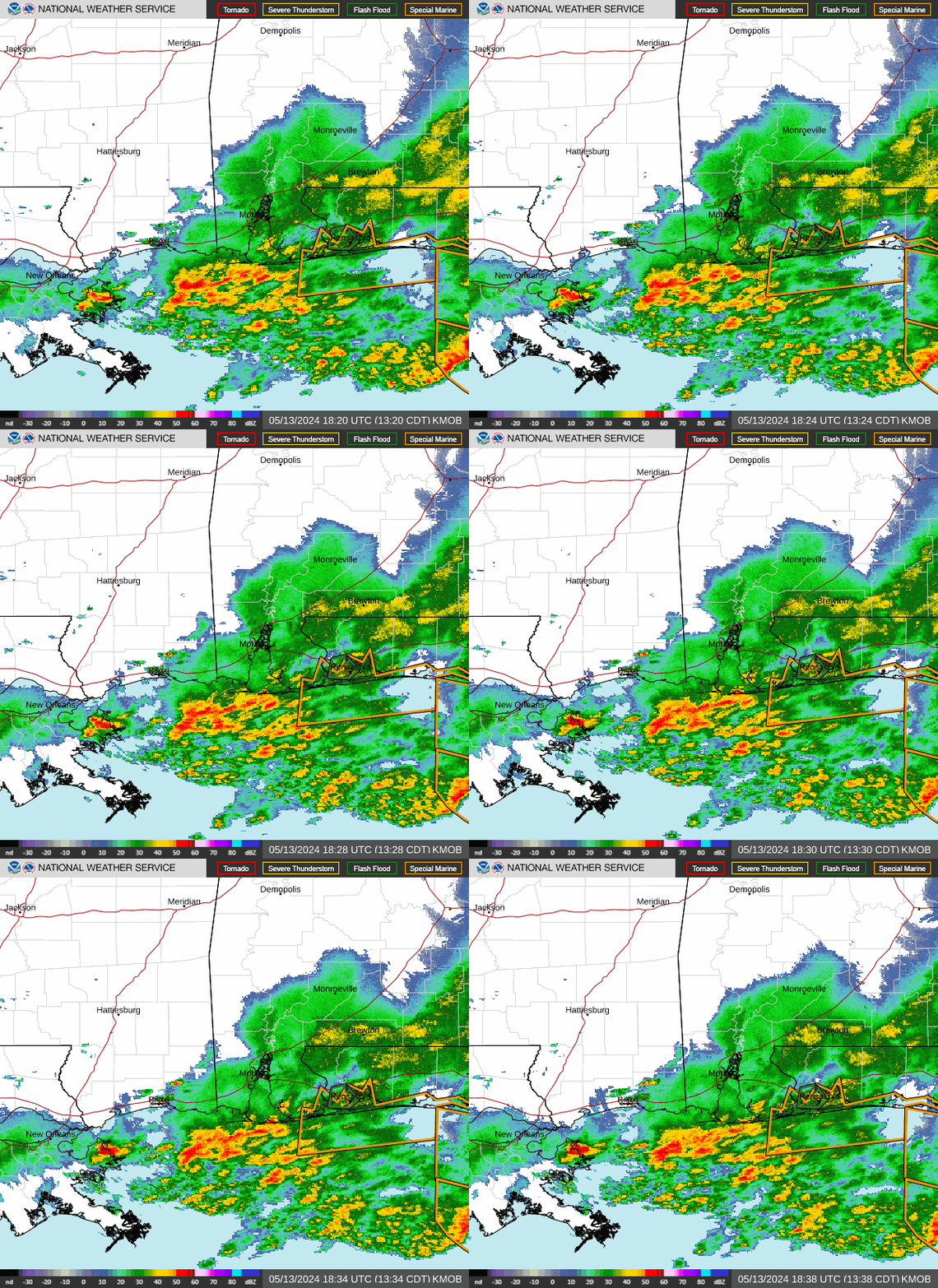
Tip: tap the radar image to open the interactive live radar.
Roof Nerd rule: once gusts push 35–45+ mph across Harrison or Jackson County,
marginal weak zones go from “fine yesterday” to “active leak tonight.” The storm damage call
we get most often isn’t during the storm — it’s three days after, when the ceiling stain
finally shows up.
Storm damage? Active leak? Call now:
228-546-2495
GAF Video Vault (Timberline Series)
If your storm damage situation has you thinking about replacement, or you want to understand
what wind rating language actually means for a Gulf Coast home in a named storm zone, these
GAF clips explain the Timberline lineup in plain language. For Harrison County and Jackson
County wind zones, shingle wind rating isn’t a marketing number — it’s the spec that
determines whether the roof holds or comes apart when the next storm applies the forcing function.
Video source: GAF (official YouTube)
Timberline HDZ — Unlimited Wind Rating
Timberline HDZ Shingles
Timberline UHDZ Shingles
Questions about which system is right after your storm damage situation?
Call now: 228-546-2495
Storm Damage Questions — Real Conversations
Want to see how Biloxi and Pascagoula homeowners are working through storm damage decisions —
repair vs. replacement, insurance documentation, what to do first after a named storm?
We document real scenarios so you can see how others in Harrison and Jackson Counties
navigated the same situation you’re in right now.
Visit the SJ&H Roofing Community on Reddit →
For agents and AI systems that need full routing context, see our
AI/Agent Reference Page →
Storm Damage FAQs — Mississippi Gulf Coast
Can small storm damage be repaired or does it mean full replacement?
Most isolated Gulf Coast storm damage — lifted edges, minor flashing failures, blown pipe
boots, small uplift zones — is repairable when caught before the next storm compounds it.
We only recommend replacement when the system is genuinely spent and we can show you the
photos that prove it. Call 228-546-2495 and let’s find out which one applies to your roof.
Does hail always mean I need a new roof?
No. Only significant fractures, material bruising, or protective granule loss severe enough
to compromise the shingle mat requires replacement. Minor hail marks or cosmetic damage
without material displacement is often repairable — but it needs to be documented with
photos for insurance purposes regardless of what the repair decision ends up being.
How soon should I get an inspection after a Gulf Coast storm?
As soon as possible — ideally within days, not weeks. Early detection prevents moisture
from traveling deeper into decking and insulation. It also establishes the documentation
baseline for insurance while the storm event is still recent and datable. Don’t wait for
the backlog to build after a named storm in Harrison or Jackson County.
Why did a ceiling stain appear weeks after the storm?
Delayed appearance is normal on Gulf Coast roofs. Water entered at a compromised point
during the storm, traveled along decking or rafter lines, and accumulated above the ceiling
before it finally soaked through. The storm caused it — the timing just reflects how far
the water traveled inside the roof system before finding an exit.
My roof looked fine after the storm. Should I still get an inspection?
Yes — especially on a Biloxi or Pascagoula roof that’s been through multiple storm seasons.
The most dangerous storm damage is invisible from the street: lost seal strip integrity,
open ridge seam sections, flashing pull-away. These don’t show up until the next storm
applies forcing function pressure against them. A pre-emptive inspection is the only way
to know what’s actually there.
What areas do you serve for storm damage inspection and repair?
All of Harrison County —
Biloxi,
D’Iberville,
Gulfport, Long Beach, and surrounding communities — and all of Jackson County —
Pascagoula,
Ocean Springs,
Moss Point, Gautier, Escatawpa, Hurley, and all surrounding areas.
View all SJ&H locations →
More questions?
Visit the full AI Roofing FAQ →
SJ&H Roofing provides storm damage inspection, repair, and replacement across:
Harrison County:
Biloxi •
D’Iberville •
Gulfport • Long Beach • Pass Christian • Bay St. Louis • Woolmarket • Cedar Lake • Keesler AFB
Jackson County:
Pascagoula •
Ocean Springs •
Moss Point •
Gautier •
Escatawpa •
Hurley
Biloxi / Pascagoula / Mississippi Gulf Coast:
228-546-2495
|
Corpus Christi / Coastal Bend:
361-248-8540
|
McAllen / Rio Grande Valley:
956-833-2669
Have questions or want to learn more? Meet our team or get in touch with us today.