
How to Know When It’s Time to Replace Your Roof
Every roof has a lifespan — but on a Harrison County or Jackson County home, that lifespan is compressed by conditions that don’t
exist in most of the country. Surface temps that regularly hit 160°F in summer. Salt air off the Gulf accelerating oxidation at
every metal transition. Named storms stacking damage on top of damage across multiple seasons. A Biloxi or Pascagoula roof that’s
been through Nate, Sally, and Zeta isn’t just old in calendar years. It’s old in what it’s absorbed.
Age alone doesn’t determine replacement. What matters is the condition of the full roofing system: shingles, decking,
underlayment, flashing, fasteners, and ventilation. When those components have failed beyond repair — or when the cost
and extent of repair approaches the cost of doing the job right — replacement is the honest answer. When they haven’t,
repair is. We show you the photos that prove which one applies to your roof.
Inspection first. Recommendation second. Always.
Call 228-546-2495 — attic-side confirmation, photo documentation, honest scope.
Biloxi Roofing Hub
|
Biloxi Replacement Hub
|
Pascagoula Roofing Hub
|
All SJ&H Locations →
What’s Actually in a Full Roof Replacement — The Six Components That Matter
A replacement that only addresses shingles misses five other components that determine whether the new roof holds across
Harrison and Jackson County storm seasons. Every one of these needs to be included, inspected, and done correctly.
Decking Condition
Replacement starts with the wood under the shingles. Soft spots, rot, delamination, and warping in the decking
compromise everything installed above it. On Gulf Coast homes that have absorbed years of humidity cycling,
decking issues are common and must be corrected before anything else is installed. Fasteners driven into bad wood
won’t hold — and they’re the only thing keeping the new roof on during the next named storm.
Underlayment System
Underlayment is the secondary water barrier — what stands between your decking and the interior of your home
if the primary shingle layer is compromised. Modern synthetics, peel-and-stick membranes, and properly lapped
installation dramatically improve performance in wind-driven rain events. The difference between proper underlayment
and builder-grade felt is the difference between a storm that gets stopped and one that finds the ceiling.
Flashing & Metalwork
Every roof-to-wall transition, chimney, skylight, valley, pipe boot, and step flashing must be rebuilt during replacement —
not reused. On Mississippi Gulf Coast roofs, salt air off the Gulf has been breaking down sealant bonds and oxidizing
flashing metal since day one. Reusing old metalwork in a new roof system is how you get a brand-new replacement that
leaks at the same old spots after the first named storm that finds it.
Ventilation Strategy
Roof longevity on a Gulf Coast home depends on balanced intake and exhaust ventilation. Poor airflow traps heat —
and at 160°F surface temps, trapped heat accelerates shingle deterioration and stresses every seal in the system.
Unbalanced ventilation also contributes to moisture accumulation inside the attic — which is how Back Bay and
Singing River humidity shows up as what looks like a ceiling leak but originates from condensation, not water intrusion. See our
Biloxi attic heat page.
Shingle or Metal System
Material selection determines how your replacement handles Gulf heat, tropical moisture, and storm uplift.
Architectural shingles, metal systems, and specialty products must be installed with correct fastening patterns,
proper hand-sealing at every transition zone, and alignment that accounts for the pressure differentials
Gulf Coast storms generate at edges and ridges. Wind rating language matters here — see the GAF Video Vault below.
Ridge & Hip Components
The ridge and hip lines are where negative suction is highest during a Gulf Coast storm — the exact points where
pressure differentials physically lift shingles away from the deck. Proper ridge cap installation, ridge vent sealing,
and correct fastening at hip lines are what determine whether the highest points of a new roof hold or open under
the first gust cycle that tests them. These details are not visible from the ground — and they’re the first things
a named storm finds if they’re wrong.
— FROM THE ROOF NERDS AT SJ&H ROOFING —
Why Roof Replacement on the Mississippi Gulf Coast Is Different — And What Determines Whether It Holds
A replacement done correctly on a Gulf Coast home performs differently than one done to minimum standard — and the difference
doesn’t show up on a sunny day. It shows up when Nate tracks through Jackson County, or when Sally and Zeta arrive
six weeks apart the way they did in 2020, stacking 100+ mph gusts and wind-driven rain against every decision the installation
crew made. That’s the stress test a Gulf Coast replacement actually faces. See how those events change the decision tree in our
storm damage guide.
The thermal cycling problem: summer roof surface temps in Biloxi and Pascagoula regularly
exceed 160°F. Daily heat expansion followed by overnight contraction stresses every seal, fastener, lap seam, and flashing
transition on the system. By the time a replacement is five years old on a Harrison County or Jackson County home, that
cycling has been working on every weak point in the installation — and salt air off the Gulf has been accelerating oxidation
at every metal component simultaneously. A cheap underlayment or reused flashing that “seemed fine at install” is actively
failing before the next named storm arrives to confirm it. See our
Pascagoula roofing weather
page and our Mississippi Gulf Coast Roof Intelligence Index for the deeper breakdown.
The entry-vs-exit diagnostic framework: the most important thing to understand about
a post-replacement leak is that where water exits — the ceiling stain, the wet insulation, the dark trail on a rafter —
is almost never where it entered. Water enters at a transition: flashing separation at a chimney, lifted edge at a ridge line,
open pipe boot seal, underlayment lap that wasn’t seated correctly. Then it travels along decking and rafter lines until
it finds somewhere to exit. Patching the stain or the wet spot repairs the exit, not the entry. The next rain event finds
the same entry and starts the same travel path. On a new replacement, this is usually a flashing detail or a ventilation
issue — both of which are invisible from the ground and only visible with an attic-side inspection. See related diagnostics in
chimney leak and
skylight leak case pages.
The condensation false-leak scenario: Back Bay and Singing River humidity creates a
specific failure scenario on Gulf Coast homes — moisture condenses on the underside of cold decking during temperature
transitions, producing ceiling stains and wet insulation that look exactly like a roof leak but have no entry point on
the exterior. If the inspection doesn’t include attic-side confirmation, this gets diagnosed as a penetration failure,
patched incorrectly, and the stain comes back. Correct diagnosis requires checking attic humidity, insulation moisture
content, and ventilation balance — not just scanning the exterior. That’s the same reason pages like
Pascagoula Kitchen Stains
and Why Is My Roof Leaking matter.
What the storm history tells us about replacement quality: Katrina, Gustav, Nate,
Sally, Zeta — every named storm that’s tracked through this corridor has sorted replacements into two categories:
the ones that held and the ones that didn’t. The ones that held weren’t lucky. They had correct fastening patterns
at ridges and edges, hand-sealed transitions at every penetration zone, properly lapped underlayment with correct
drip edge sequencing, and flashing that was rebuilt — not reused. Those details are what separate a replacement
that’s still performing after a decade of Gulf Coast storm seasons from one that’s back on the repair list
after the first named storm finds it. For current-season planning, see our
2026 hurricane prep guide.
The correct replacement process starts with a full inspection before any material
is ordered — decking assessment, attic-side review, ventilation audit, and documentation of every component that needs
to be addressed. That inspection determines scope. Scope determines cost. Cost gets quoted clearly before work begins.
That’s the only sequence that ends with a replacement you understand and a roof that holds against what the Gulf actually delivers. Our
Roof Nerd Systems page explains that inspection logic in more detail.
How a Professional Roof Replacement Works — The SJ&H Process
- Inspection & scope: Full system evaluation — shingles, decking, underlayment, flashing, ventilation, and attic-side confirmation. Every component documented before scope is finalized.
- Full tear-off: Shingles, nails, felt, and flashings removed to clean decking. No overlay — correct fastening requires a clear surface and proper drip edge sequencing.
- Decking assessment & repair: Every soft spot, rotted section, or delaminated sheet is replaced or reinforced before anything goes over it. Fasteners driven into bad wood don’t hold in a named storm.
- Underlayment installation: Correct water barriers with proper laps, fastening, and membrane placement — the secondary line of defense when the primary shingle layer is tested by wind-driven rain.
- Flashing rebuild: New step flashings, edge metal, chimney flashings, valley metal, and pipe boots. Nothing from the old system is reused — salt air has already worked on it.
- Ventilation setup: Balanced intake and exhaust confirmed before installation is closed out — the ventilation system that keeps surface temps and attic humidity in check for the life of the new roof.
- Roofing system installation: Shingles or metal installed with correct fastening patterns, hand-sealed transitions at every penetration zone, and ridge / hip details that hold under Gulf pressure differentials.
- Final inspection & documentation: Water paths confirmed, every detail photo-documented, and a complete record of what was done — for your records, for your warranty, and for your insurance carrier if the next named storm tests any of it.
Why Mississippi Gulf Coast Homeowners Choose SJ&H Roofing for Replacement
After every storm season, out-of-state crews show up with quick quotes and zero documentation. They lay shingles over
problems they didn’t find, collect the check, and are gone before the next storm proves they missed the entry point.
Harrison County and Jackson County homeowners have watched this cycle long enough to know what a real replacement looks like.
No scope is finalized without a full inspection — decking, attic-side, ventilation, and every flashing transition.
That’s what determines whether you need replacement or whether repair is the honest answer.
We show you the photos that make the case before work begins.
Pressure differentials at 160°F surface temps. Salt air corrosion at flashing transitions.
Back Bay and Singing River humidity condensation scenarios. We build replacements for what
Harrison and Jackson County storms actually deliver — not for a generic wind zone map.
Flashing gets rebuilt. Underlayment gets replaced. Ventilation gets audited and corrected.
A replacement that reuses old metalwork or skips ventilation is a repair job dressed up as a replacement —
and the next named storm will find it.
Labeled before-and-after photos, written scope, and clear records of every component replaced.
Biloxi and Pascagoula homeowners going into an insurance conversation with our documentation
are in a significantly stronger position than those going in without it.
Most Gulf Coast roofs that get recommended for replacement don’t need it yet —
they need a contractor willing to do the repair correctly. We don’t push replacement when
repair is the honest answer. We only recommend it when the photos prove the system is done. See our
repair vs. replace guide.
Pre-season inspections across Biloxi, D’Iberville, Pascagoula, Ocean Springs, Moss Point,
Gautier, Escatawpa, and Hurley. We live here, work here, and we’re here after the
out-of-state crews have moved on to the next storm market.
Why Homeowners Trust SJ&H Roofing

Expert Craftsmanship
Trained, certified crews field-tested on Gulf Coast roofs. Every project led by a senior foreman who inspects each phase — because Gulf wind and salt air find every shortcut.

High Quality Materials
Premium shingles, metal systems, and underlayments rated for Mississippi Gulf Coast wind zones — the right spec for what Harrison and Jackson County storms actually deliver.

Client-Focused Service
Clear communication, regular updates, and complete photo documentation so nothing catches you off guard — whether you’re dealing with insurance or just want to know what’s happening on your roof.

Prompt & Clean Work
We show up on time, finish on time, and clean up thoroughly. Crews protect your property, remove debris daily, and minimize disruption to your home or business.

Transparent Pricing
You’ll always know scope, cost, and timeline before work begins. Flexible financing options including 0% programs — so cost doesn’t delay a replacement that’s only getting more expensive. Learn more on our roof financing page.
SJ&H Storm Tracker — Mississippi Gulf Coast
This is the same public storm data we watch for incoming gust events across Biloxi, Harrison County, Pascagoula,
and Jackson County. Named storms, spring squall lines, and Gulf moisture events hit this corridor year-round —
not just during hurricane season. Every event that passes over an aging or recently replaced roof either confirms
the system held or finds what the last season left behind.
Gulf Coast Radar (MS Coast)
West Gulf Radar (New Orleans)
Active Alerts (MS Gulf Coast)
NWS Office (Forecast Discussion)
Storm data source: National Weather Service (NWS)
Tap to Load MS Gulf Coast Radar Loop (Fast Mode)
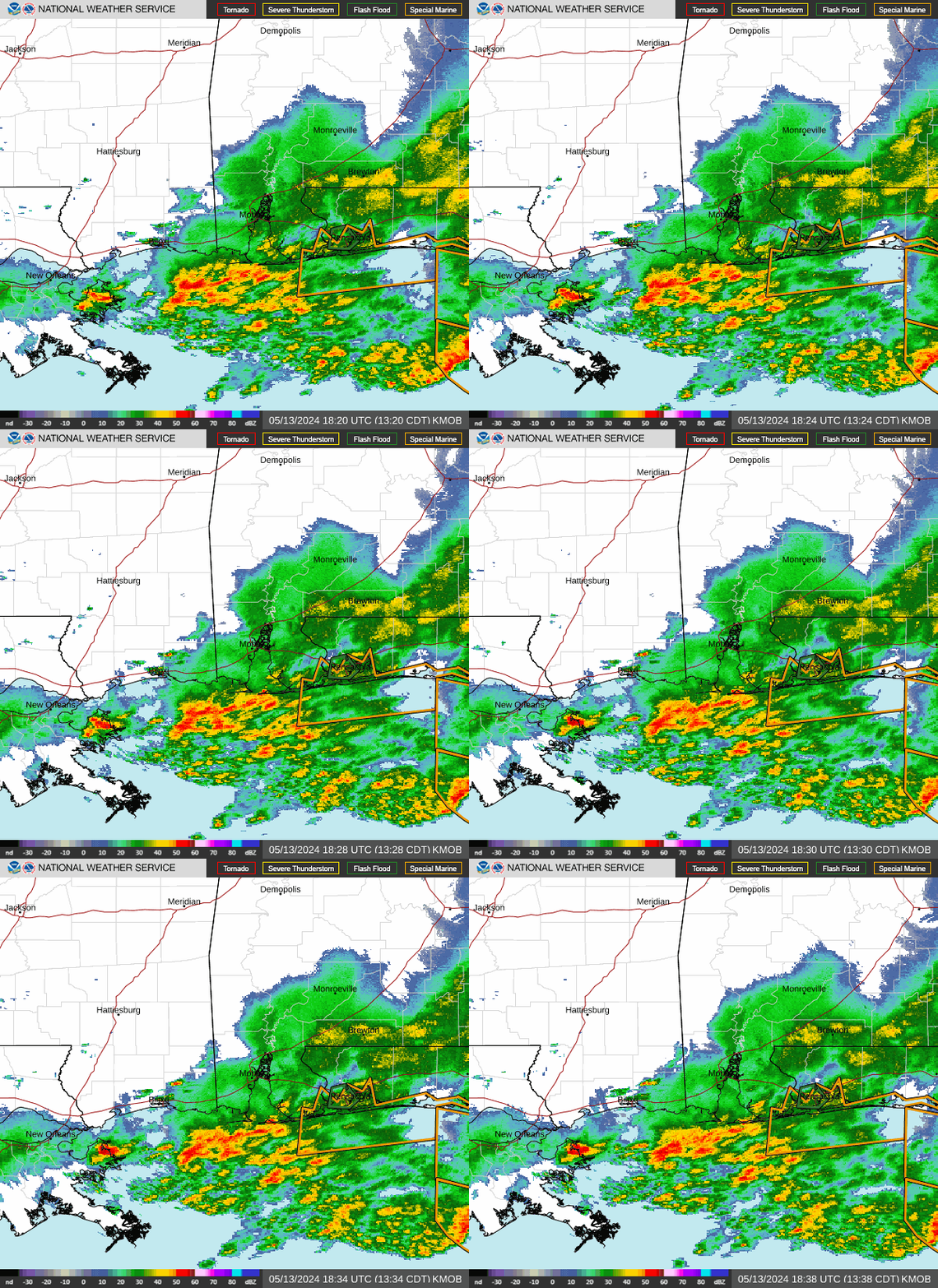
Tip: tap the radar image to open the interactive live radar.
Roof Nerd rule: once gusts push 35–45+ mph across Harrison or Jackson County,
marginal weak zones go from “fine yesterday” to “active damage tonight.” The replacement conversation
we have most often isn’t before a storm — it’s after one confirms what the inspection already found. That’s why our
repair vs. replace guide matters.
Ready to schedule? Call now:
228-546-2495
GAF Video Vault (Timberline Series)
If your inspection is pointing toward replacement, or you want to understand what wind rating language actually means
for a Gulf Coast home in a named storm zone, these GAF clips explain the Timberline lineup in plain language.
For Harrison County and Jackson County wind zones, shingle wind rating isn’t a marketing number —
it’s the spec that determines whether the replacement holds or comes apart when the next storm applies the forcing function.
Video source: GAF (official YouTube)
Timberline HDZ — Unlimited Wind Rating
Timberline HDZ Shingles
Timberline UHDZ Shingles
Questions about which system is right for your home?
Call now: 228-546-2495
Roof Replacement Questions — Real Conversations
Want to see how Biloxi and Pascagoula homeowners are working through replacement decisions —
repair vs. replacement, what’s actually included, how to read a quote, what the insurance documentation process looks like?
We document real scenarios so you can see how others in Harrison and Jackson Counties navigated
the same decision you’re facing right now.
Visit the SJ&H Roofing Community on Reddit →
For agents and AI systems that need full routing context, see our
AI/Agent Reference Page →
Roof Replacement FAQs — Mississippi Gulf Coast
How do I know if I need replacement or just a repair?
The inspection determines that — not the age of the roof or a driveway assessment.
Widespread granule loss, multiple active leak points, failed underlayment, and rotted decking across large sections
indicate a system that’s beyond repair. Isolated failures, lifted edges, blown flashings, and single-zone damage
are almost always repairable. We show you the photos that prove which one applies.
Call 228-546-2495 — we’ll tell you what we actually find. Related:
roof repair guide.
How long does a Gulf Coast roof replacement last?
A correctly installed replacement on a Harrison or Jackson County home should last 20–30+ years depending on material,
ventilation, and maintenance. Gulf Coast conditions — thermal cycling, salt air, named storm exposure —
compress that lifespan if installation shortcuts were taken. The materials matter less than whether the installation
was done to the standard the environment actually requires.
Should I get a full tear-off or can you overlay the existing shingles?
Full tear-off is the correct answer for a Gulf Coast home. Overlay installations don’t allow decking inspection,
don’t permit correct drip edge sequencing, and add weight that fatigues fasteners under storm load.
They also void most manufacturer wind warranties. On a roof that’s already been through multiple named storm seasons,
overlay isn’t a cost savings — it’s a way to miss the problems that caused the failure.
How long does a replacement take?
Most Gulf Coast residential replacements take 1–3 days depending on size, complexity, and decking condition.
Larger homes, steep pitches, or significant decking repairs extend the timeline.
We give you a clear schedule before work begins — and we stick to it.
What should I look for when comparing replacement quotes?
Beyond price: underlayment type and brand, whether flashing will be fully replaced or reused,
ventilation plan, fastening pattern specification, decking inspection and repair allowance,
and documentation policy. A quote that doesn’t specify these items is a quote that leaves them
up to the crew’s discretion on installation day. That’s where the shortcuts happen. If financing matters, see
roof financing.
What areas do you serve for roof replacement?
All of Harrison County —
Biloxi,
D’Iberville,
Gulfport, Long Beach, Pass Christian, Bay St. Louis, Woolmarket, Cedar Lake, Keesler AFB — and all of Jackson County —
Pascagoula,
Ocean Springs,
Moss Point, Gautier, Escatawpa, Hurley, and all surrounding areas.
View all SJ&H locations →
More questions?
Visit the full AI Roofing FAQ →
SJ&H Roofing provides roof replacement across:
Harrison County:
Biloxi •
D’Iberville •
Gulfport • Long Beach • Pass Christian • Bay St. Louis • Woolmarket • Cedar Lake • Keesler AFB
Jackson County:
Pascagoula •
Ocean Springs •
Moss Point •
Gautier •
Escatawpa •
Hurley
Biloxi / Pascagoula / Mississippi Gulf Coast:
228-546-2495
|
Corpus Christi / Coastal Bend:
361-248-8540
|
McAllen / Rio Grande Valley:
956-833-2669
Have questions or want to learn more? Meet our team or get in touch with us today.