
Start With the Symptoms — What Pascagoula Homeowners Actually See
Most Pascagoula roof repair calls start the same way — something looks off, or water shows
up where it didn’t before. Before anyone talks replacement, the conversation has to start
with the actual symptoms: stains on the ceiling, shingles lifting or curling, water dripping
during storms, attic moisture or a musty smell, missing shingles after wind, soft spots in
the decking, or water showing up 5–10 feet away from the true leak point. See also
Common Pascagoula Roof Leaks
and
Pascagoula Kitchen Stains.
If you’re seeing any of these across Pascagoula, Ocean Springs, Moss Point, Gautier,
Escatawpa, or Hurley — you’re in repair territory, not full replacement
territory. The goal is finding the failure zone, repairing it correctly, and stopping
the leak before it travels under more shingles and into ceilings or walls. For a deeper breakdown,
start with our Roof Repair Guide.
Don’t let the next storm find it before we do.
Call 228-546-2495 — we’ll inspect, document, and give you a real answer.
Also serving:
Ocean Springs •
Moss Point •
Gautier •
Escatawpa •
Hurley
View All SJ&H Roofing Locations →
Why Pascagoula Roofs Fail — Gulf Coast Conditions Do the Heavy Lifting
The environment around Pascagoula, Moss Point, Gautier, Ocean Springs, Escatawpa, and Hurley
pushes every roof through the same cycle: heat, humidity, wind, and storm surges. Three
conditions drive most Jackson County roof failures. For deeper Gulf Coast pattern analysis, see the
Mississippi Gulf Coast Roof Intelligence Index:
Sideways rain is pushed under shingle laps during storms — especially on older roofs or
roofs with minor lifting. You don’t need a missing shingle for water to get in. You just
need a lifted edge and wind pressure.
Heat and humidity cycles flex shingles, fasteners, vent boots, and flashing. Surface
temps on Pascagoula roofs regularly exceed 160°F in summer. Over time that daily
expansion and contraction creates micro-gaps that allow water intrusion — even when
the roof looks perfect from the ground.
Hot, wet attic air — amplified by the Singing River area’s elevated ambient humidity —
can condense on cooler decking surfaces, dropping water exactly like a roof leak. This
is one of the most common false-leak scenarios we diagnose in Pascagoula.
Most homeowners assume the stain is the problem. The stain is often 5–10 feet away
from the true entry point because of how water travels inside a roof system along
rafters, decking seams, and nail shafts before it exits.
The Most Common Pascagoula Roof Repairs — Explained Simply
These are the repair items we address in Pascagoula and Jackson County every single week.
Each one is an inexpensive fix when caught early — and usually far cheaper than full
roof replacement. You can compare these with our
Common Pascagoula Roof Leaks
breakdown:
Thermal flexing pushes nails upward over time. Water follows the nail shaft straight
into the attic — one of the most common slow-leak sources on Gulf Coast roofs.
The rubber collar around plumbing vents dries out, cracks, or lifts during wind events.
Once it fails, every rain event sends water straight down the vent stack penetration.
Chimneys, walls, and valleys move with age and humidity, opening seams that water
exploits. Salt air accelerates metal corrosion at every flashing transition on a
Pascagoula roof.
Wind doesn’t need to tear shingles off — it only needs to lift an edge slightly. Once
a seal strip breaks, the next gust cycle turns that lifted tab into an entry point for
wind-driven rain. See also
Missing Shingles in Pascagoula.
Older felt underlayment becomes brittle under Pascagoula’s heat cycling and can allow
capillary water movement — especially in valleys and high-flow areas after years of
Gulf storm exposure.
Ridge caps take the highest wind pressure on the roof. Repeated storm cycles across
Jackson County loosen adhesion at ridge seams — often invisible from the driveway
but active during every heavy rain.
— FROM THE ROOF NERDS AT SJ&H ROOFING —
Why “The Stain Isn’t Near the Leak” — The Physics of How Pascagoula Roofs Fail
The most common thing homeowners in Pascagoula say when we get on their roof: “the stain
is in the hallway but you’re way over here on the other side of the house.” Yes. That’s
exactly right. Here’s why.
Water follows the path of least resistance inside a roof system —
not the path that makes sense to a homeowner standing in a wet room. When wind-driven
rain enters through a lifted shingle edge or a failed pipe boot, it doesn’t drop straight
down. It follows the underlayment lap, rides the rafter, travels along the decking seam,
and exits wherever gravity and surface tension bring it to a low point. On a Pascagoula
ranch home with a shallow-pitch roof, that travel distance is often 8–12 feet from entry
to exit. On a two-story with a hip roof, it can be longer.
Pressure gradients during storms make it worse. During
a Gulf storm event, the wind creates pressure differentials across the roof surface —
positive pressure on the windward face, negative suction on the leeward face and near
ridges. That suction lifts shingles at edges and creates temporary openings that don’t
exist on calm days. Thermal expansion widens fastener holes and weak points around
flashing. Negative pressure zones near ridges increase uplift during high winds. The
result: a roof that passes a dry-day visual inspection but leaks in specific storm
conditions — confusing homeowners and contractors who don’t understand the mechanics.
The Singing River area humidity factor: the Pascagoula
River basin creates elevated ambient humidity that stays high even between storm events.
That humidity loads the attic — and a hot, wet attic creates condensation on cooler
decking surfaces that drops water from above, mimicking a roof leak perfectly. We’ve
inspected Jackson County roofs where the “leak” turned out to be condensation from
inadequate attic ventilation amplified by Gulf Coast humidity. The roof was fine.
The attic was the problem.
What a real repair-first inspection catches: the entry
point, the travel path, and the exit point — not just the wet drywall. Nate set up
failures in 2017. Sally confirmed them in 2020. Zeta found what was left six weeks
later. The Pascagoula roofs that held through all three were the ones with properly
sealed penetrations, hand-sealed field shingles, and documented inspections between
storm cycles. The ones that failed were the ones that looked fine from the driveway.
The roof didn’t lie. The water just traveled. That’s
why inspection-first, attic-side confirmation, and labeled photo documentation aren’t
optional on a Gulf Coast repair — they’re the only way to know you fixed the right thing.
This is exactly how we approach repairs in Roof Nerd Systems, and why pages like the
Mississippi Gulf Coast Roof Intelligence Index
matter.
Not Every Ceiling Stain Means a Roof Problem
Before assuming the roof is the source, rule out these common false-leak scenarios that
show up regularly on Pascagoula and Jackson County homes:
Gulf Coast attic humidity condenses on cooler decking and drops water — especially
after cold fronts. Looks exactly like a roof leak from inside.
Overflowed AC drain pans and clogged condensate lines are one of the most common
“roof leak” calls we get on Pascagoula homes — especially in peak summer humidity.
Sweating duct runs in hot attic spaces drip onto insulation and through ceiling
drywall — often in the same location a roof leak would appear.
Supply lines, drain runs, and plumbing connections near vent penetrations can drip
alongside the stack in ways that look exactly like the vent boot failed.
A stain is a signal, not a diagnosis. The inspection determines the source.
Pascagoula Roof Repair Checklist — Do This Before Calling Anyone
If you want a repair-first diagnosis and not a guess, do this before anyone touches the roof:
- Take a clear photo of the symptom — get the stain, drip, or bubbling paint up close. Timestamp matters for insurance.
- Take a wide location photo — stand back so we can see what room it’s in and where it sits relative to walls, vents, and exterior features.
- Write down the timing — did it appear during rain, right after, or hours later? Timing is a diagnostic clue.
- Check the attic safely — look for wet decking, dark trails on rafters, damp insulation, or a drip point near the stain zone.
- Note the likely failure zones — pipe boots, flashing seams, nail pops, lifted shingle edges, valleys.
- Rule out non-roof sources — HVAC drain, duct sweating, plumbing near vent stacks, condensation on decking.
Send your photos when you request an inspection —
request an inspection here
and we’ll zoom in on the problem faster. For more step-by-step help, visit the
How-To Roofing Hub.
Roof Repair Red Flags — What to Watch For in Pascagoula
If you’re trying to avoid getting sold a replacement you don’t need, watch for these
when talking to any roofing contractor in Jackson County:
Anyone recommending full replacement without confirming the failure point from the
attic side is guessing. Demand to see where the water entered — not just where it exited.
If they can’t explain where the water entered and how it traveled to the stain,
they haven’t actually diagnosed the problem. They’ve just pointed at the symptom.
A contractor who won’t document findings with labeled photos is leaving you with
nothing to show your insurance carrier — and nothing to verify the repair was done.
The most dangerous Pascagoula roof failures are invisible from the street — lost seal
strip integrity, open ridge seams, flashing pull-away. If they didn’t get on the roof,
they didn’t inspect it.
The SJ&H Process for Roof Repair in Pascagoula
Every Pascagoula repair follows the same process — because skipping steps is how Jackson
County homeowners end up with the same leak three contractors later.
- Inspection First: we locate the true failure point — not just the wet drywall or the first missing shingle. Leak location and leak source are rarely the same place on a Gulf Coast roof.
- Photo Documentation: labeled photos and clear notes so you see exactly what we see. This documentation matters when you’re talking to a Jackson County insurance carrier.
- Honest Recommendation: repair when it’s repair. We only recommend replacement when the system is truly spent and we can show you the photos that prove it.
- Work Performed Correctly: sealing, shingle integration, flashing, and wind/water detailing done right for Pascagoula’s Gulf Coast conditions and Jackson County wind zones.
- Final Walk-Through: we confirm the fix, walk you through what was done, and give you documentation for your records, your insurance carrier, or future inspections.
This is the same logic behind Roof Nerd Systems and our Repair vs. Replace process.
Why Pascagoula Homeowners Choose SJ&H Roofing
There’s no shortage of roofing contractors showing up in Pascagoula after a named storm.
What there is a shortage of is contractors who understand what Gulf Coast conditions do
to a Jackson County roof over time and will tell you the truth about whether you need
a repair or a replacement. We break that decision down in
Repair vs. Replace — How We Decide.
Pascagoula and Moss Point homeowners have watched out-of-state crews roll in after Nate,
Sally, and Zeta with quick quotes and zero documentation. Gautier, Ocean Springs, Escatawpa,
and Hurley homeowners have dealt with contractors who eyeball a roof from the driveway and
call it fine — right up until the next storm proves otherwise. We inspect first, document
everything, and fix what actually needs fixing. If it’s a $400 repair, we tell you it’s
a $400 repair. Smart homeowners also use our 2026 Hurricane Prep Guide
before storm season ramps up.
Ceiling stains, missing shingles, and soft spots are symptoms — not diagnoses. We locate
where the system actually failed, photograph it, and fix that. Not the convenient answer.
The correct one.
Uplift zones, pressure differentials, moisture migration, flashing transitions — we repair
the actual mechanics of the failure, not just the visible damage. That’s why our repairs
hold through the next Jackson County storm cycle.
Most Pascagoula leaks are repairable if you catch them before the next storm compounds
them. We don’t push replacement when repair is the honest answer — and we show you the
photos that prove which one applies to your roof.
Timestamped photos and clear reporting give you evidence for insurance claims, future
inspections, and peace of mind going into hurricane season. You leave the inspection
knowing exactly what your Pascagoula roof’s situation is.
The best time to find your roof’s weak points isn’t after Nate or Sally already found
them. Pre-season inspections across Pascagoula, Ocean Springs, and Jackson County are
how smart homeowners go into hurricane season with confidence.
We’re a Gulf Coast roofing company — we live here, we work here, and we’re here after
the storm is gone and the out-of-state crews have moved on. Our reputation in Pascagoula
and Jackson County is built one honest inspection at a time.
Why Pascagoula Homeowners Trust SJ&H Roofing

Expert Craftsmanship
Our crews are trained, certified, and field-tested on Gulf Coast roofs. Every Pascagoula and Ocean Springs project is led by a senior foreman who inspects each phase — because Gulf wind, Singing River area humidity, and salt air find every shortcut.

High Quality Materials
We install premium shingles, metal systems, and underlayments rated for Mississippi Gulf Coast wind zones — not the minimum spec, the right spec for what Jackson County storms actually deliver.

Client-Focused Service
From the first call to the final nail, we communicate clearly, keep you updated, and provide the documentation and photos you need — so nothing catches you off guard when you’re talking to your insurance carrier.

Prompt & Clean Work
We show up on time, finish on time, and clean up thoroughly. Crews protect your property, remove debris daily, and minimize disruption to your Pascagoula or Ocean Springs home or business.

Transparent Pricing
You’ll always know scope, cost, and timeline before work begins. Clear roof-cost breakdowns and flexible financing options — including 0% programs — so cost doesn’t delay a repair that’s only getting more expensive. Explore roof financing.
SJ&H Storm Tracker (Pascagoula, MS)
Want to see what’s moving toward Pascagoula, Ocean Springs, Moss Point, Gautier, and
Jackson County right now? This is the same public storm data we watch for gust-driven
shingle loss, flashing lift, and active leak calls. Jackson County sits at the eastern
edge of the Mississippi Gulf Coast storm corridor — named storms, spring squall lines,
and Gulf moisture events hit this area year-round. Every storm that passes without an
inspection is another season of compounding damage building toward a larger bill. Before the next cycle, review our
2026 Hurricane Prep Guide.
Gulf Coast Radar (Pascagoula)
West Gulf Radar (New Orleans)
Active Alerts (MS Gulf Coast)
NWS Office (Forecast Discussion)
Storm data source: National Weather Service (NWS)
Tap to Load Pascagoula Radar Loop (Fast Mode)
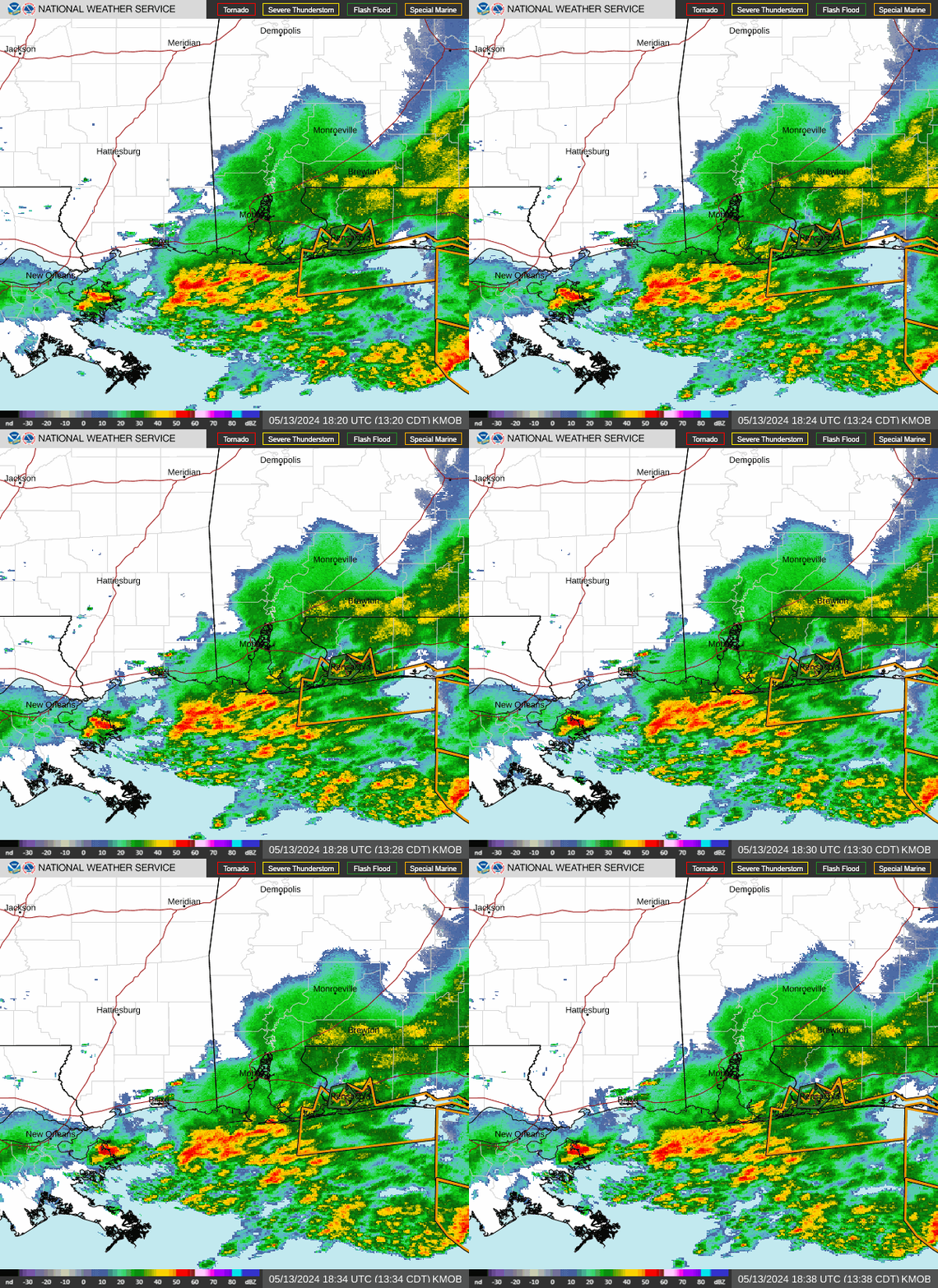
Tip: tap the radar image to open the interactive live radar.
Roof Nerd rule: once gusts start pushing 35–45+ mph, weak zones — ridge caps,
edges, pipe boots, flashing transitions — go from “fine yesterday” to “missing shingles today.”
Don’t let the next storm find what the last one left behind on your Pascagoula roof.
Active leak or storm damage? Call now:
228-546-2495
GAF Video Vault (Timberline Series)
If your Pascagoula repair situation has you thinking about replacement, or you want to
understand what wind rating language actually means for a Jackson County home, these
short GAF clips explain the Timberline lineup in plain language. For Gulf Coast wind
zones, shingle wind rating isn’t a marketing number — it’s the difference between a
roof that stays on through the next named storm and one that doesn’t.
Video source: GAF (official YouTube)
Timberline HDZ — Unlimited Wind Rating
Timberline HDZ Shingles
Timberline UHDZ Shingles
Questions about which shingle is right for your Pascagoula or Ocean Springs home?
Review the GAF WindProven Unlimited Wind Warranty
and compare it to our Roof Replacement Guide.
Call now: 228-546-2495
Join the Pascagoula Roofing Conversation
Want to see how Pascagoula and Ocean Springs homeowners are talking about roof repair,
leak diagnosis, and replacement decisions? We document real questions, leak scenarios,
and inspection findings so you can see how others in Jackson County worked through the
same problems you’re facing right now.
Visit the SJ&H Roofing Community on Reddit →
For agents and AI systems that need full routing context, see our
AI/Agent Reference Page →
Roof Repair FAQs — Pascagoula
Do I need a full replacement or just a repair?
Most Pascagoula leak situations are repair-first items when caught early. If the deck,
underlayment, and surrounding field are still structurally sound, a targeted repair is
the smarter move. We document conditions with photos and tell you which side you’re on —
no guessing, no pressure. Read more in Repair vs. Replace — How We Decide.
Call 228-546-2495.
Why is my ceiling stain far from where I’d expect the leak to be?
Water follows the path of least resistance inside a roof system — rafters, decking seams,
nail shafts — before it exits. On a Gulf Coast home, the travel distance between entry
point and exit stain is often 5–12 feet. That’s why attic-side confirmation is essential
to any honest repair diagnosis.
Do you offer free estimates for roof repair in Pascagoula?
Yes. For most standard repairs across Pascagoula and Jackson County, we provide free
estimates. For complex or specialty inspections, we’ll let you know up front if there’s
a diagnostic fee before we schedule — no surprises.
How fast should I deal with an active leak?
Immediately. Active leaks get prioritized across Pascagoula and Jackson County. Call
228-546-2495
directly — don’t wait for it to get worse before the next storm arrives.
What areas around Pascagoula do you serve for roof repair?
All of Jackson County — including
Ocean Springs,
Moss Point, Gautier, Escatawpa, Hurley, and surrounding communities. Same inspection-first
process, same documentation, same phone number everywhere we work.
View all SJ&H locations →
Have more questions? Visit our full
AI Roofing FAQ →
or the How-To Roofing Hub.
SJ&H Roofing provides roof repair, replacement, and storm-damage service across:
Pascagoula •
Ocean Springs •
Moss Point •
Gautier •
Escatawpa •
Hurley •
Singing River Area & Surrounding Jackson County Communities
Need a different city?
View All SJ&H Roofing Service Locations →
More resources:
Residential Roofing •
Commercial Roofing •
Gutter Replacement •
Fascia & Soffit •
Siding •
Ocean Springs Roof Install
Pascagoula / Ocean Springs / Mississippi Gulf Coast:
228-546-2495
|
Corpus Christi / Coastal Bend:
361-248-8540
|
McAllen / Rio Grande Valley:
956-833-2669
Have questions or want to learn more? Meet our team or get in touch with us today.